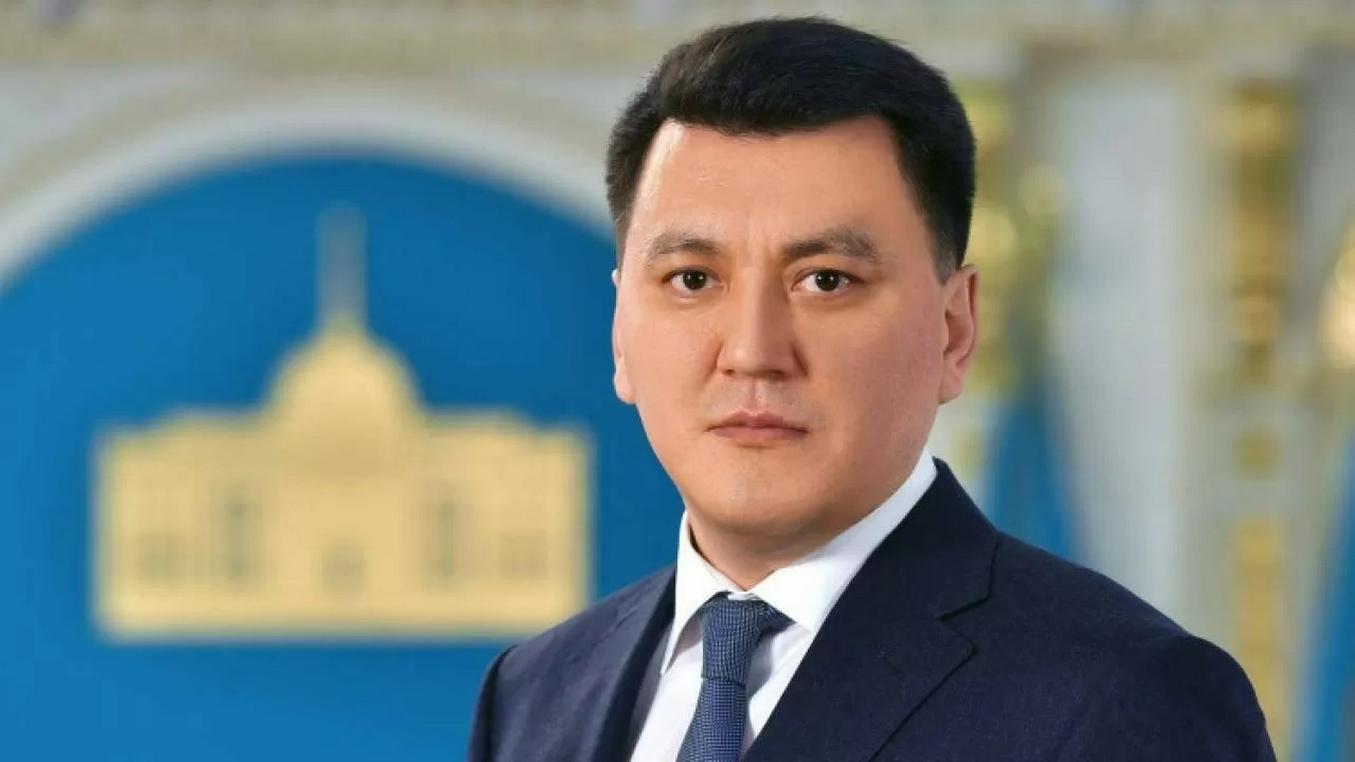
On August 31, 2026, Kazakh President Kassym-Jomart Tokayev signed a decree appointing Erlan Karin as vice president of the republic. The post was revived after the 2026 constitutional reform — a similar office had previously existed in Kazakhstan under Nursultan Nazarbayev. Karin is widely regarded as one of the chief ideologists of Akorda, the presidential administration. His appointment has fueled speculation about a possible succession scenario. How realistic is that scenario, and how have Karin's views shifted over the past two decades? Fergana takes a closer look.
From Teacher to Presidential Aide
Erlan Karin was born on May 26, 1976, in the village of Aksu in the Sairam district of what was then Chimkent (now South Kazakhstan/Turkestan) region of the Kazakh SSR. In 1997 he graduated from the history department of Aktobe University, named after K. Zhubanov. He later earned a candidate degree in political science from Al-Farabi Kazakh National University.
He began his career as a schoolteacher and lecturer before moving into leadership roles at analytical and research institutions.
A turning point came in 2003, when Karin became first deputy chairman of the Asar party, founded by Dariga Nazarbayeva, daughter of former president Nursultan Nazarbayev. Karin was effectively responsible for the party's ideological direction, according to the Caspian Institute.
At the same time, from 2004 to 2006, he headed the International Institute for Contemporary Politics and later the Center for Counter-Terrorism Programs, while also leading an expert group on Kyrgyzstan. During this period Karin built working relationships with influential figures in the Kazakh elite, including Prime Minister Karim Massimov and National Security Committee (KNB) chairman Nurtai Abykayev.
Karin's interest in security issues is reflected in his academic and journalistic work, which includes studies of terrorism and radical movements in Central Asia, as well as a book examining possible scenarios for a transfer of power in Kazakhstan. He was also involved in developing combat sports, serving as president of the national jiu-jitsu federation and sitting on the governing bodies of several sports federations — a lesser-known chapter of his biography detailed by Sports24.kz.
Between 2006 and 2008, Karin served as political adviser to the governor (akim) of Mangistau region, a role in which he grew close to Krymbek Kusherbayev. During this period he also met Nurlan Nigmatulin, who later headed the Presidential Administration.
In February 2008, Karin moved to the Presidential Administration, where he ran the domestic policy department until November of that year. He then became secretary of the Nur Otan people's democratic party, then chaired by Nigmatulin.
In late 2013 he spent a year in the United States as a visiting professor at American University in Washington, D.C. Upon returning in 2014, he took charge of the Kazakhstan Institute for Strategic Studies under the president, and three years later became head of the state broadcaster, the Kazakhstan Republican Television and Radio Corporation.
After Tokayev's election as president in 2019, Karin became his adviser and later secretary of the National Council of Public Trust. From July 2020 he served as a presidential aide.
In January 2022, Tokayev appointed Karin state secretary of Kazakhstan. After that post was abolished in June of the same year, Karin became state counselor.
In early 2026, the president once again proposed abolishing a number of state and administrative bodies, including the post of state counselor. Announcing the move, Tokayev turned to Karin, seated to his right, and said in English, «I'm very sorry» — a moment widely covered by Kazakh media. The regret proved short-lived: from June 30 Karin became first deputy head of Tokayev's administration, and on August 31 he was named vice president.
Thirty Years Later
The post had already existed in independent Kazakhstan under former president Nursultan Nazarbayev. The first and only vice president was Erik Asanbayev, who held the office from the republic's declaration of independence on December 16, 1991.
On February 22, 1996, Nazarbayev dismissed Asanbayev and abolished the post itself. Asanbayev was effectively sent into diplomatic exile in Germany, returning to Kazakhstan only in 2000 as a retiree; he died four years later.
«It was Asanbayev who helped Nazarbayev win the battle for power after [Dinmukhamed] Kunayev, when he faced rivals such as [Zakash] Kamalidenov and [Keshrim] Aulbekov,» political scientist Sarym Itkulov recalled on his Telegram channel.
Alongside the vice-presidency, Kazakhstan's early years of independence also featured a unicameral parliament, the Supreme Soviet, which held broad powers. «Nazarbayev was accountable to it and had very limited authority. But his patience lasted only about two years. In 1995–96 he dissolved the Supreme Soviet along with everyone who might have held him to account since the Kunayev era,» Itkulov noted.
Against this backdrop, the political scientist sees the simultaneous return of both institutions three decades later as symbolic. «Who would have thought that after 30 years both the unicameral parliament and the office of vice president would return to Kazakhstan? It's as if the circle has closed,» he added.
A Possible Successor
Tokayev first proposed reviving the vice-presidency in early 2026, speaking at a session of the National Kurultai (which was not yet a parliament at the time).
«The vice president, acting on the president's instructions, is expected to represent the interests of the Republic of Kazakhstan at international forums and in negotiations with foreign delegations, represent the president's interests in parliament, engage with domestic and foreign public, political, scientific and cultural organizations, and carry out other assignments from the head of state,» Tokayev said, outlining the future deputy's responsibilities.
That March, a referendum in Kazakhstan approved a new constitution that formally established the status of vice president.
Under the new provisions, the vice president is not only expected to carry out the president's instructions but would also assume the presidency if the president's term ends early.
This has fueled speculation that the vice-presidency carries more than technical significance, and that its holder is being positioned as a potential successor to Tokayev. Karin's name had circulated as a possible successor even before his appointment, but the move has intensified such speculation. Still, it is too early to speak of a guaranteed succession, says Stanislav Pritchin, head of the Central Asia sector at the Russian Academy of Sciences' Institute of World Economy and International Relations (IMEMO).
«Erlan Karin appears to have won the current round of the intra-elite power struggle and will become the second-ranking figure in the republic's hierarchy. But this is clearly an interim victory, given the high pace of internal developments — there have already been three constitutional reforms in recent years,» the expert wrote on his Telegram channel.
According to Pritchin, only the broad contours of future developments can be discerned for now. Early presidential elections in 2027 have not been ruled out. At the same time, the sitting president could also run in such a vote — a possibility recently confirmed by the Constitutional Court. Under these conditions, the vice-presidency loses some of the strategic weight it appeared to carry in the original version of the reform, the expert believes.
Political analyst Arkady Dubnov likewise cautions against viewing Karin as Tokayev's guaranteed successor.
«Under Kazakhstan's new constitution, the vice president does not have an independent political profile. He is not elected on a joint ticket with the president, as in the United States, but is essentially the president's chief troubleshooter. If he fails to carry out the tasks Tokayev assigns him, the president has the right to dismiss him and appoint someone else in his place,» Dubnov wrote on his Telegram channel.
This feature of the new political architecture, he said, is one of the central puzzles of the reform.
«Does Erlan Karin's rise to this senior post guarantee his future as Tokayev's successor? A 100 percent 'yes' is nowhere in sight,» the analyst concludes.
Ideologist of the «New Kazakhstan»
Karin developed as a political figure largely in Tokayev's orbit. He is described as one of the ideologists of the «New Kazakhstan» project and a key architect of the political messaging that has defined the Tokayev era.
The newspaper Uralsk Week recalled some of Karin's earlier statements in this context. In the early 2000s, the outlet notes, he viewed political competition as a condition for state stability.
After the 2004 parliamentary elections, Karin wrote that the vote should have «laid the foundation for competitive politics in Kazakhstan,» but that the authorities instead solved «the technical problem of securing a pro-presidential majority.» Discussing the official results, Karin also referred to «the fact of large-scale falsification of election results across the country."
His stance toward the opposition was equally notable. Karin warned that barring political opponents from parliament and other legal institutions risked pushing discontent onto the streets. He returned to this theme later: in 2014 he described citizens' desire to protest publicly as normal and warned that «a deepening crisis of the opposition is no cause for celebration."
In his view, weakening organized opposition narrows legal channels for expressing discontent and raises the risk of spontaneous unrest. Around the same time, he offered his own definition of stability: «Stability doesn't mean everyone is satisfied and no one is upset.» True social resilience, Karin argued, lies in tolerating the existence of discontented citizens while ensuring the authorities listen and respond to them.
By 2024, Karin still acknowledged the need for political pluralism, but his rhetoric increasingly emphasized the concept of «red lines.» On June 5, 2024, while serving as state counselor, he published a policy article titled «Consolidation and Development» in the state newspaper Kazakhstanskaya Pravda, subtitled «Conceptual Foundations of President Kassym-Jomart Tokayev's Political Course,» as noted by Uralsk Week. In it, Karin argued that the universal concept of «Justice» underpins Kazakhstan's contemporary ideology, with «A Just Kazakhstan» as the central ideological formula of state policy.
A significant portion of the article was devoted to the concept of a «New Ideological Platform.» Karin wrote that Tokayev's policies since 2019 rest on five core concepts. The first, «Different Opinions, One Nation,» addresses what justice and «A Just Kazakhstan» mean. The second, «A Listening State,» defines the mechanism for achieving this through effective feedback with the public. The third, «Law and Order,» sets out the methods and tools for establishing justice. The fourth — «a strong president, an influential parliament, an accountable government» — defines the institutional model of «A Just Kazakhstan.» The fifth, «Adal Azamat» («Honest Citizen»), outlines the moral and spiritual guidelines for the development of society and civil society.
At the same time, Karin defined the limits of acceptable public discourse by introducing the concept of «red lines.» He noted that Kazakhstan is home to a range of political views, but argued that the growth of pluralism must be balanced against the priority of national interests.
«Public debate must recognize a so-called 'red line,' crossing which poses risks to social stability and runs counter to the country's national interests. 'Red lines' are not taboos, censorship, or a ban on discussing certain topics or issues. They are a call for correctness and restraint in political discourse,» Karin emphasized.
He specifically urged public figures, media outlets, bloggers, and civic activists to avoid deepening social divisions or stoking conflict around the most sensitive issues, which he identified as interethnic and language relations, religious matters, and foreign policy.
Over two decades, Erlan Karin's public rhetoric has shifted markedly. Where he once focused chiefly on political competition and the need to account for the views of the discontented, he now speaks of social consolidation, national interests, and «red lines.» Today's Karin has not abandoned the idea of pluralism, but seeks to fit it within stricter boundaries set by the state. How strict those boundaries will prove to be is something Kazakhs will find out in the near future.
-
 01 September01.09Just Look, Don't Say You Didn't SeeAn Islamic civilization media forum in Tashkent gathered over 300 journalists from nearly 50 countries
 -
 30 August30.08The Real Intrigue Comes LaterObservers and experts assess Kazakhstan’s first elections to the new Kurultai parliament
 -
 21 August21.08Elections to a Weakened KurultaiBerit Lindeman, Secretary General of the Norwegian Helsinki Committee, on democracy and the parliamentary campaign in Kazakhstan
 -
 10 August10.08A Caravan in the Expanse of the UniverseHuman rights defender and journalist Farid Tukhbatullin on the past, present, and future of the Turkmen people
 -
 16 June16.06A Dam Named After One FamilyThe world's tallest dam is being built in Tajikistan on empty reserves and other people's loans
 -
 27 May27.05The Price of “Water Diplomacy”While Emomali Rahmon receives an honorary certificate “from the UN”, the Amu Darya keeps running shallow…
-
What lies behind Kiriyenko’s visit to Uzbekistan?
-

Alisher Aminov on Italy's failure, Michel Platini, the «Iran case» and chaos at FIFA
-
Why Kyrgyzstan Dismissed an Influential “Gray Cardinal” and What May Follow
-
Japan to invest about $20 billion in projects across Central Asia over five years