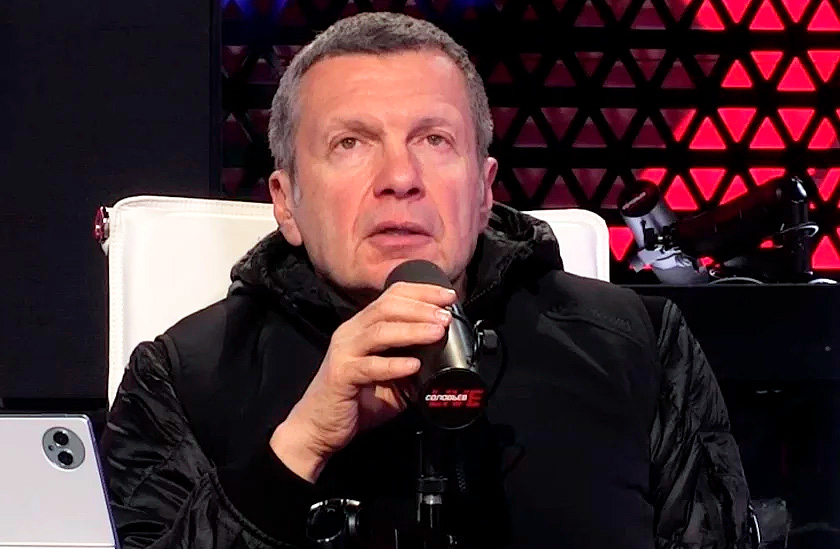
 Vladimir Solovyov. Video still.
Russian television host Vladimir Solovyov referred to Central Asia as “ours” and suggested the possibility of conducting a “special military operation” (SVO) in Russia’s zones of influence. The remarks were made on the January 10 broadcast of Solovyov Live.
Commenting on the U.S. military operation in Venezuela and Donald Trump’s claims regarding Greenland, Solovyov said Washington disregards international law and takes whatever it wants. For Moscow, he argued, developments in Venezuela or Syria matter less than the situation in the so-called near abroad.
“We should not be dealing with Syria or Venezuela right now. We should not lose our positions, but what matters most to us is our near abroad. What is happening in Armenia is far more painful for us than what is happening in Venezuela. Losing Armenia—that would be a gigantic problem. Problems in our Asia, in Middle Asia, in Central Asia, as it is called—this could be a gigantic problem for us,” Solovyov said.
He went on to say that Russia needs to “very clearly formulate its goals and objectives” and make it clear that “the games are over.”
“To hell with international law and the international order. If, for our national security, it was necessary to begin an SVO on the territory of Ukraine, why, based on the same considerations, can we not begin an SVO in other points of our zone of influence?” the television host asked.
Solovyov proposed “formulating our national doctrine and clearly stating what our zone of influence is. Then everything will be clear.”
There has been no official reaction to Solovyov’s statements in Central Asian countries. Public outrage was strongest in Uzbekistan. Bobur Bekmurodov, chairman of the Yuksalish movement and a member of parliament, said that “such provocations only turn neighbors into enemies.”
“The times have changed. The era when the fate of nations was decided by shouting from television studios or instructions from ‘older brothers’ has long been consigned to the dustbin of history. Our borders are our honor and dignity. Any threat to independence will be met not with ‘submission,’ but with a united and firm response from the nation,” Bekmurodov warned.
Sherzod Kudratkhodja, rector of the University of Journalism and Mass Communications of Uzbekistan, described Solovyov’s remarks as an expression of “pure colonial language,” in which sovereign states are treated as objects and borders as obstacles.
“This is the normalization of war as an acceptable instrument of politics. Ukraine has become a precedent, Central Asia the subject of openly voiced fantasies, and the ‘zone of influence’ a universal justification for any violence wrapped in the language of security,” the rector said.
Kudratkhodja expressed hope that the Russian television host’s words were merely a propaganda device rather than a reflection of the Kremlin’s official position, but noted that such statements rarely remain just rhetoric. In his view, the formula of “Our Asia” and calls to ignore international law point to an attempt to normalize war as a legitimate political tool, with the notion of a “zone of influence” serving as a catch-all justification for violence.