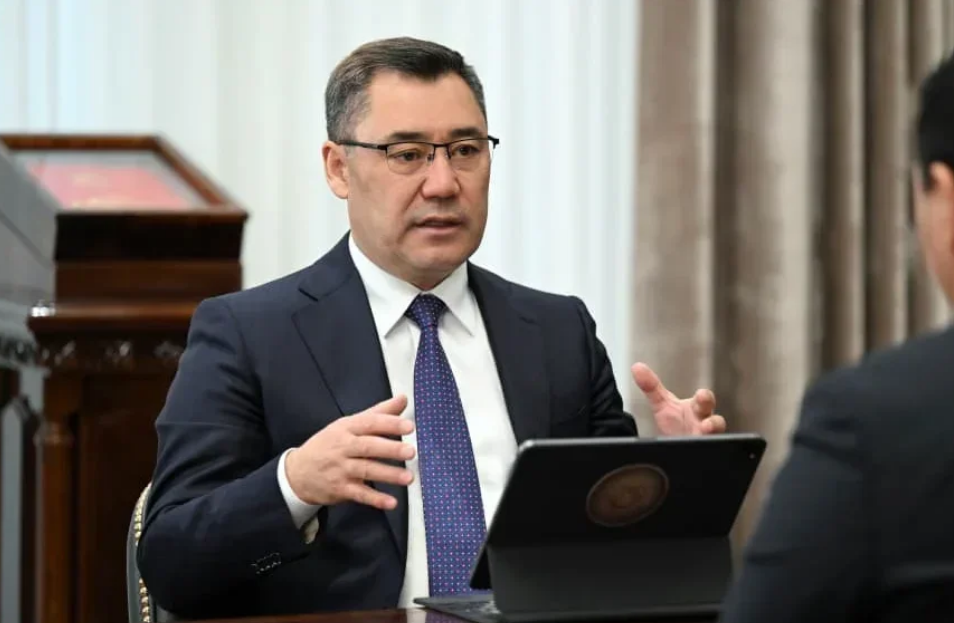
 Sadyr Japarov. Photo: kabar.kg
President of Kyrgyzstan Sadyr Japarov has announced plans to establish an Investigative Committee that will report directly to the head of state. The statement was reported by the state news agency Kabar.
According to Japarov, the new body will assume all investigative functions, which, he said, will ensure the independence of investigations and the protection of citizens’ rights.
“The General Prosecutor’s Office and the Military Prosecutor’s Office will supervise the legality of the actions of all bodies. If you ask why we need to create an Investigative Committee — we must think about the future and the sustainability of the state,” the president said in an interview with Kabar.
Japarov acknowledged that cases of unjust investigations do occur in the country, as the heads of the Interior Ministry and the State Committee for National Security (SCNS) can insist that investigators initiate cases against individuals allegedly “set up” by оперативные сотрудники.
“The Investigative Committee will report directly to the president. It simply will not accept ‘raw’ or fabricated cases brought by operatives or ministers. Criminal cases will not be initiated. Of course, citizens who encounter injustice will not end up behind bars — they will be released immediately. Only in this way can we ensure the protection of human rights, if not 100%, then at least 95%. This will guarantee security for future generations,” Japarov explained.
The reform is expected to begin next year.
“We will prepare the buildings and technical base. A decree will be issued, and the relevant draft laws will be submitted to the Jogorku Kenesh, and after their adoption, organizational work will begin,” Japarov said.
As for the State Committee for National Security (SCNS), it will focus exclusively on its core functions: intelligence and counterintelligence, protection of the constitutional order, and combating terrorism, extremism, banditry, and drug trafficking.
“The agency will retain investigative powers specifically in these areas. It will not interfere in the economy. No one should know exactly what the SCNS does or who its employees are. After the reform, it will be a true special service, similar to the KGB,” the Kyrgyz president emphasized.
Discussions about creating an Investigative Committee began in mid-February amid the resignation of the SCNS leadership headed by Kamchybek Tashiev and statements about the need for a systemic “reset” of Kyrgyzstan’s law enforcement agencies. A number of experts have pointed to potential risks associated with establishing the new body.
Lawyer Kanat Khasanov recalled that the idea of an Investigative Committee had been discussed before 2017 and that draft legislation had already been developed at that time. In his view, such a body is necessary in principle, but much depends on its institutional model. If the new agency is granted authority solely over official misconduct cases, there is a real risk that it could become an instrument of political pressure, the lawyer warned.
Former Prime Minister Felix Kulov described the idea as interesting but cautioned against hasty decisions. In his opinion, transferring all investigative functions to a single body at once would be extremely difficult from both organizational and financial perspectives. Kulov proposed creating an investigative service under the president with regional branches and assigning it responsibility for certain categories of official crimes. Cases involving treason, espionage, and other crimes against the state, he suggested, should remain under the jurisdiction of the SCNS. General criminal offenses should continue to be investigated by the Interior Ministry, and tax crimes by its specialized units. According to the former prime minister, such a gradual approach would help avoid overburdening the system and prevent administrative chaos.