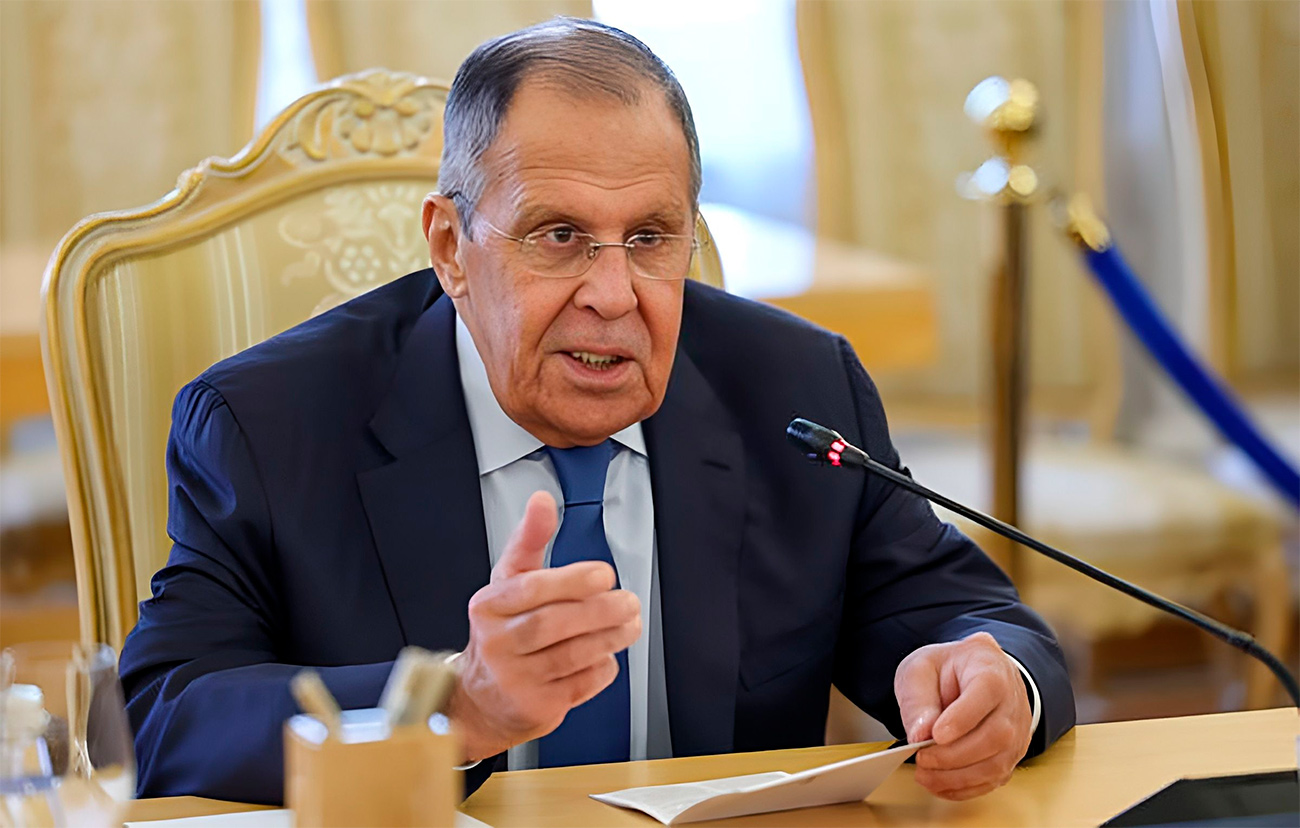
 Sergey Lavrov. Photo by TASS
Russian Foreign Minister Sergey Lavrov has praised the performance of the Taliban, which governs Afghanistan. RBC reported the remarks. Its correspondent attended the opening of the Moscow format consultations on Afghanistan.
«The national government that came to power led by the Taliban movement has brought the country's territory under control and, it must be acknowledged, is governing it fairly successfully,» Lavrov said.
He said the Taliban are waging an uncompromising fight against terrorist groups on Afghan territory.
«Hundreds of militants have been eliminated, and a number of high-profile terrorist attacks have been thwarted, including those targeting foreign citizens and diplomatic missions,» TASS quoted Lavrov as saying.
The Russian foreign minister noted that strengthening Kabul's counterterrorism capabilities serves common interests. He called for logistical and expert support, as well as contacts between intelligence services and law enforcement agencies.
According to Lavrov, Western sanctions have not stopped Afghanistan's economy from developing.
«The Afghan economy continues to develop despite harsh sanctions pressure from Western countries, which, under the pretext of protecting human rights, have cut the Islamic Emirate off from the international financial system and seized its national bank assets,» the minister said.
He added that «the Afghan authorities have confirmed their commitment to regional energy projects, including the TAPI (Turkmenistan–Afghanistan–Pakistan–India) gas pipeline, carried out tax reform, strengthened anti-corruption legislation, and revitalized industry."
Citing official data, Lavrov said about 170 new production facilities have opened in Afghanistan. He said the country has drawn up «a five-year plan for the development of the electric power industry,» and that «the volume of foreign trade, which Afghanistan conducts with more than 100 countries, grew last year to $14 billion."
The eighth Moscow format consultations on Afghanistan took place in Moscow on October 5. Participants discussed the situation in and around Afghanistan, including the conflict between Kabul and Islamabad. Special representatives and senior officials from Afghanistan, India, Iran, Kazakhstan, China, Kyrgyzstan, Pakistan, Russia, Tajikistan and Uzbekistan attended. Delegations from Belarus and Egypt were invited as guests.
Russia began building contacts with the Taliban long before the movement returned to power. The Moscow format consultations were launched in 2016, and the Taliban later joined them. After the Taliban took power in August 2021, the interaction continued, although Russia did not officially recognize the government they formed for a long time.
In 2024, Russian President Vladimir Putin said relations with the current Afghan authorities «somehow need to be built,» since they control the country's territory. In April 2025, the Supreme Court granted a lawsuit by the Prosecutor General's Office and removed the movement from Russia's list of terrorist organizations. In July of that year, Russia officially recognized the Islamic Emirate of Afghanistan. It remains the only country to have taken this formal diplomatic step.
The human rights situation remains one of the main obstacles to international recognition of the Afghan authorities. Restrictions on women and girls persist. They remain banned from education beyond the sixth grade, and their access to employment, freedom of movement and the courts is limited. According to UNESCO, the ban on secondary education affects about 2.2 million girls. The UN has also reported arbitrary detentions, pressure on the media and restrictions on freedom of speech. As the UN notes, new criminal legislation expands the list of punishable acts and allows corporal punishment. For «spreading corruption,» «heresy» and «blasphemy,» it permits penalties up to and including death.