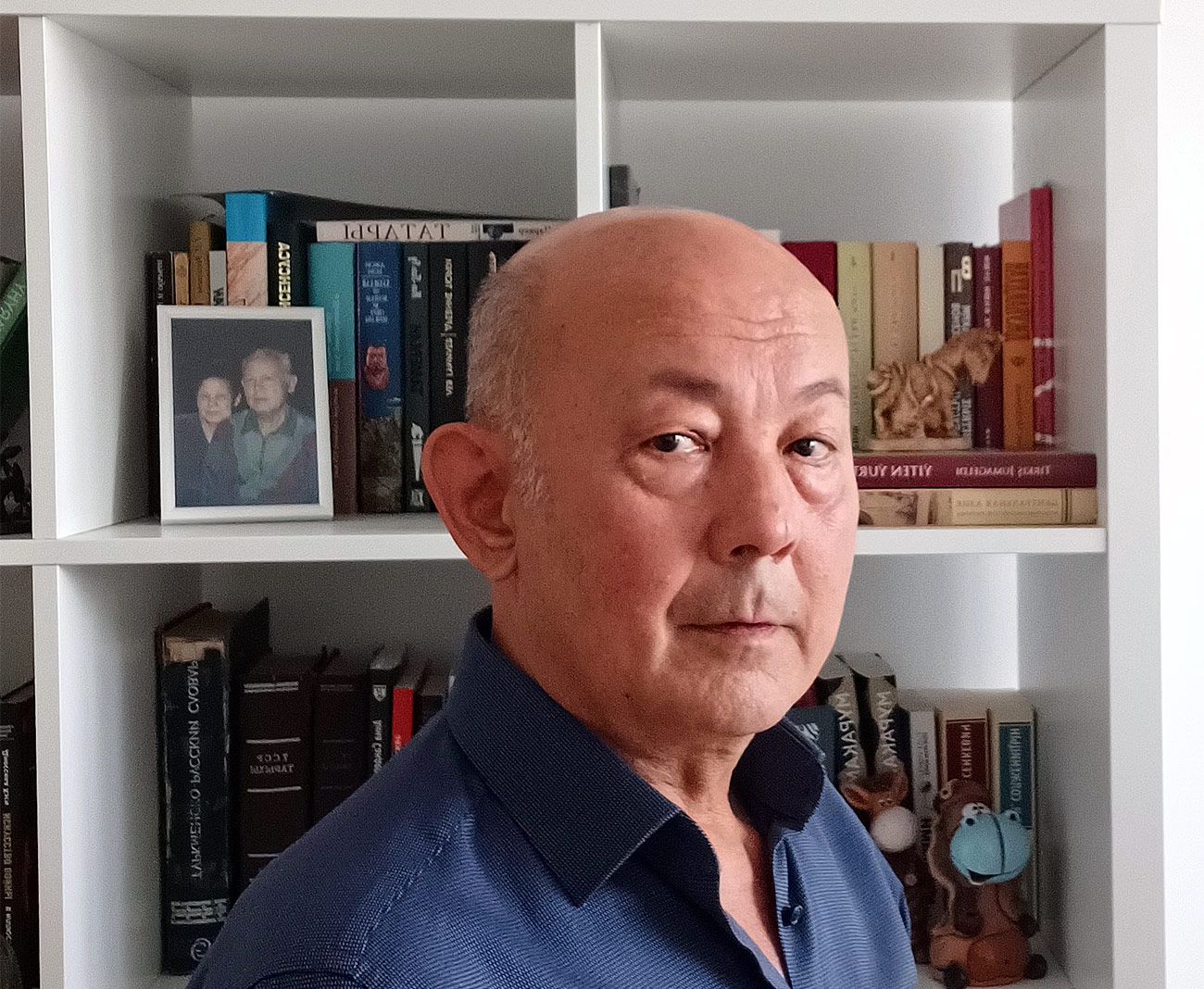
 Farid Tukhbatullin. Photo from his personal archive.
The newly published book by Farid Tukhbatullin, The Russian Colony: Turkmen Sagas, is a highly unique phenomenon on the literary horizon—one that defies easy comparison. Tukhbatullin is primarily known as a human rights activist and journalist who was imprisoned under Saparmurat Niyazov in the so-called «November case,» an alleged attempt to overthrow the authoritarian regime of Turkmenistan's first president. In this book, however, he emerges as a vivid, unconventional, and remarkably gifted writer.
The second part of the book features an account of his time in a Turkmen prison. While important and compelling in its own right, this memoir is somewhat eclipsed by the collection's other stories, which are deeply fascinating from a literary perspective. They chronicle Turkmen life across various historical epochs—spanning from times immemorial, when an ancient caravan wandered the vastness of the universe, to the modern era.
The book seamlessly and organically fuses not only past and present, but also the harsh realities of recent history with Turkmen mythology. This is not Gabriel García Márquez’s magical realism; rather, it is a kind of mythological documentary. In the fact-based story of Juma Jumaev, the Turkmen wolf-man, the «Celestial Wanderer» organically appears to rid the protagonist of his duality and return him to his original wolf nature. An old raven named «The Remembering One,» sent by the Abyss to observe humanity, discusses newspapers, books, music, and historical legends with a young raven—while also engaging in brief, amusing conversations with God.
The exchanges between the old raven and the youngling are utterly delightful. When the elder asks if the younger is interested in anything beyond his «blotting papers,» the fledgling replies:“Uh... I often fly around the park where the youth hang out, and I listen to songs outside the recording studio.”“What kind of songs? Destans [traditional epics]? Bakhshi [folk bards]? Vysotsky?”“Well, for example: ‘In the first park, the musics are playing, pretty girls are strolling back and forth, hey jan…’”“The old bird didn't let me finish, flapping his wings in displeasure. I hung my head guiltily. It seems we have a generation gap, too. He’s over a thousand furry years old, and I’m not even ten.”
Tukhbatullin possesses a remarkable sense of the absurd. This isn't just about jokes or humor, which usually require a conscious effort from the author, but rather a natural comedy that emerges as an inherent part of human existence. For instance, two Turkmen shepherds discussing recent political events mournfully complain that Lenin, who replaced the Tsar, has rounded up all the crazy people and sent them their way. It’s completely unfunny to the characters, but the reader can't help but laugh.
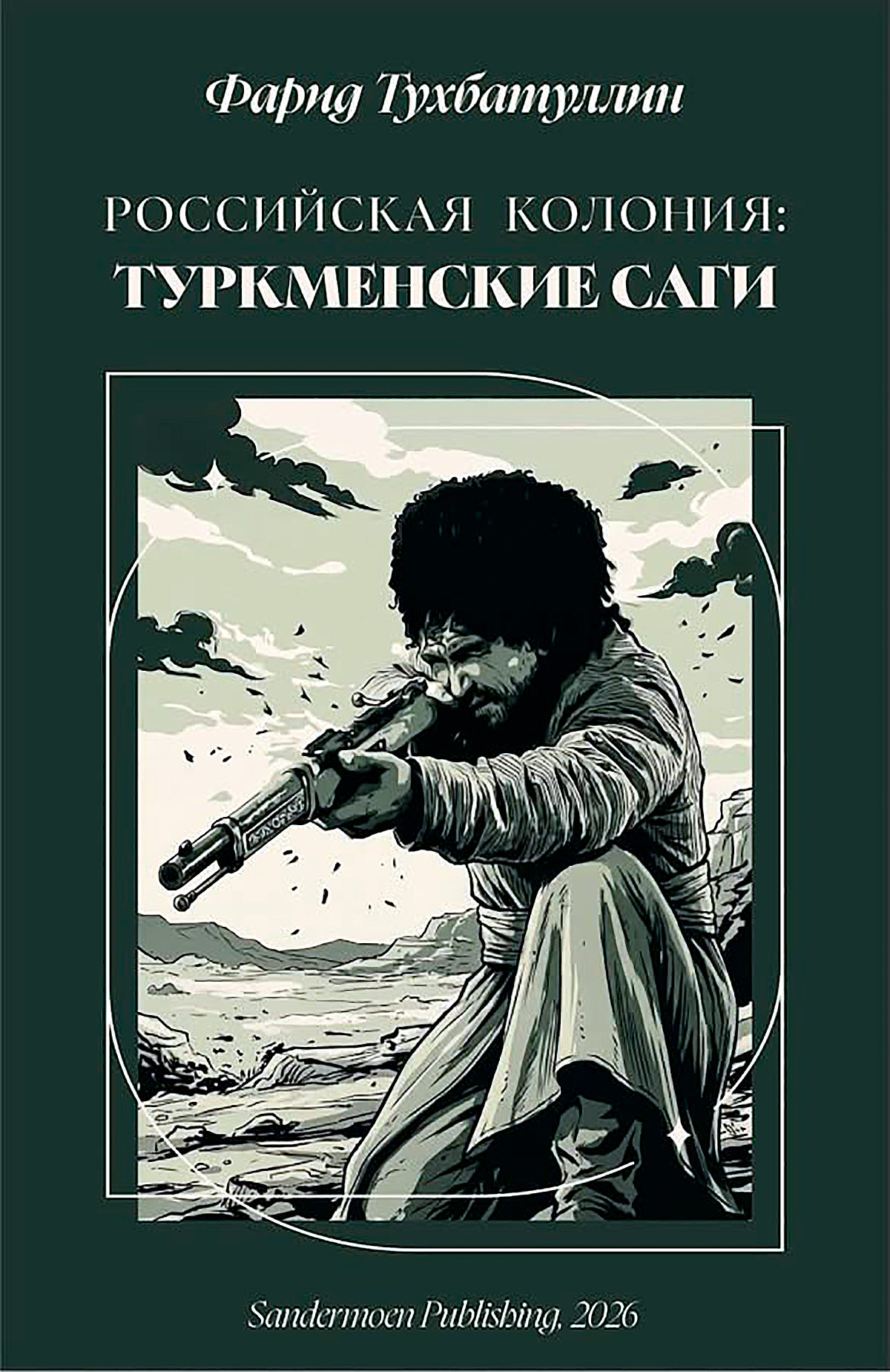 Cover of the book The Russian Colony: Turkmen Sagas. Photo from Farid Tukhbatullin's archive.
The book’s language is equally captivating. An uninitiated reader might think the author simply wrote without much thought, letting the words flow as they may. But that is certainly not the case. The book brilliantly reflects a phenomenon that could be called the «language of the imperial fringes.» Brought to Central Asia prior to the Russian Revolution, the Russian language retained a lively spontaneity there until recent decades, unburdened by the bureaucratic and syntactic clutter that weighed it down in Russia itself. This immediacy and clarity give the book an added charm.
In reality, of course, the journalist Tukhbatullin commands modern standard Russian perfectly, as is evident in the book's second half. However, his characters—and the raven narrator himself—do not get bogged down in linguistic formalities; they say what they think and exactly what they mean. This alone creates an entirely different world, far removed from the mundane, yet intensely real.
Fergana spoke with Farid Tukhbatullin about his book and the wider realities of Turkmenistan.
— The book is structured in a fascinating way: real, fully documented events merge with myths and legends. How did it end up taking such an unusual, documentary-mythological form?
— Human rights defenders have a concept called advocacy. In my case, this means spreading information as widely as possible—not just about the country's internal problems, but about the country as a whole. After all, practically no one knows anything about Turkmenistan; it is a very closed state. I needed the reader to get at least some understanding of the country itself before reading about what happened to me.
I was born and raised in a rural area. My father was also born in a village, trained first as a nurse, then as a doctor, before moving to the regional center to become the deputy head physician at the local hospital. His fellow villagers, including the elders, would come to our town to sell melons, watermelons, and pumpkins in the fall. They would drop by to see my father for business or just to visit. While my father was at work, as the eldest son, I played host—brewing tea, bringing out flatbreads, sweets, and so on. Today, I am their age, but back then, they seemed like quintessential Turkmen elders with white beards and papakha hats. They’d get bored just sitting there, so they began telling stories: legends, fairy tales, and things that had actually happened.
One of these old men had participated in the Karakum Operation, which I write about in the book. This took place in the early 1930s during the hunger riots of the so-called Basmachi rebels against the Bolshevik government. This elder had fought against Soviet rule. After the Basmachi were crushed, he served 15 years in prison. In the 1960s and 70s, people didn't talk openly about these things—only in private conversations. I was lucky to be present for them.
To be honest, as a child, I didn't entirely believe these stories because our country's history was taught completely differently in school. However, during the Perestroika years, these oral histories suddenly began to be corroborated. Archival materials and memoirs, including those of Tsarist generals, were published, and almost everything I had heard from those old men was validated.
When I set out to write a book, I started recalling all these stories, unraveling the threads of those times. They were disparate tales that I later had to piece together into a single puzzle. Naturally, they couldn't all fit into a single chapter, or even a whole book.
As for the blending of mysticism, legends, and reality, you have to remember that this is the East, and the perception of life there is slightly different. I have lived in Europe for many years now, but when I recall certain moments of life in my homeland, they don't seem entirely real—they feel somewhat like a fairy tale, somewhat mystical. This feeling likely played a role, and it's because of this that the stories took shape the way they did.
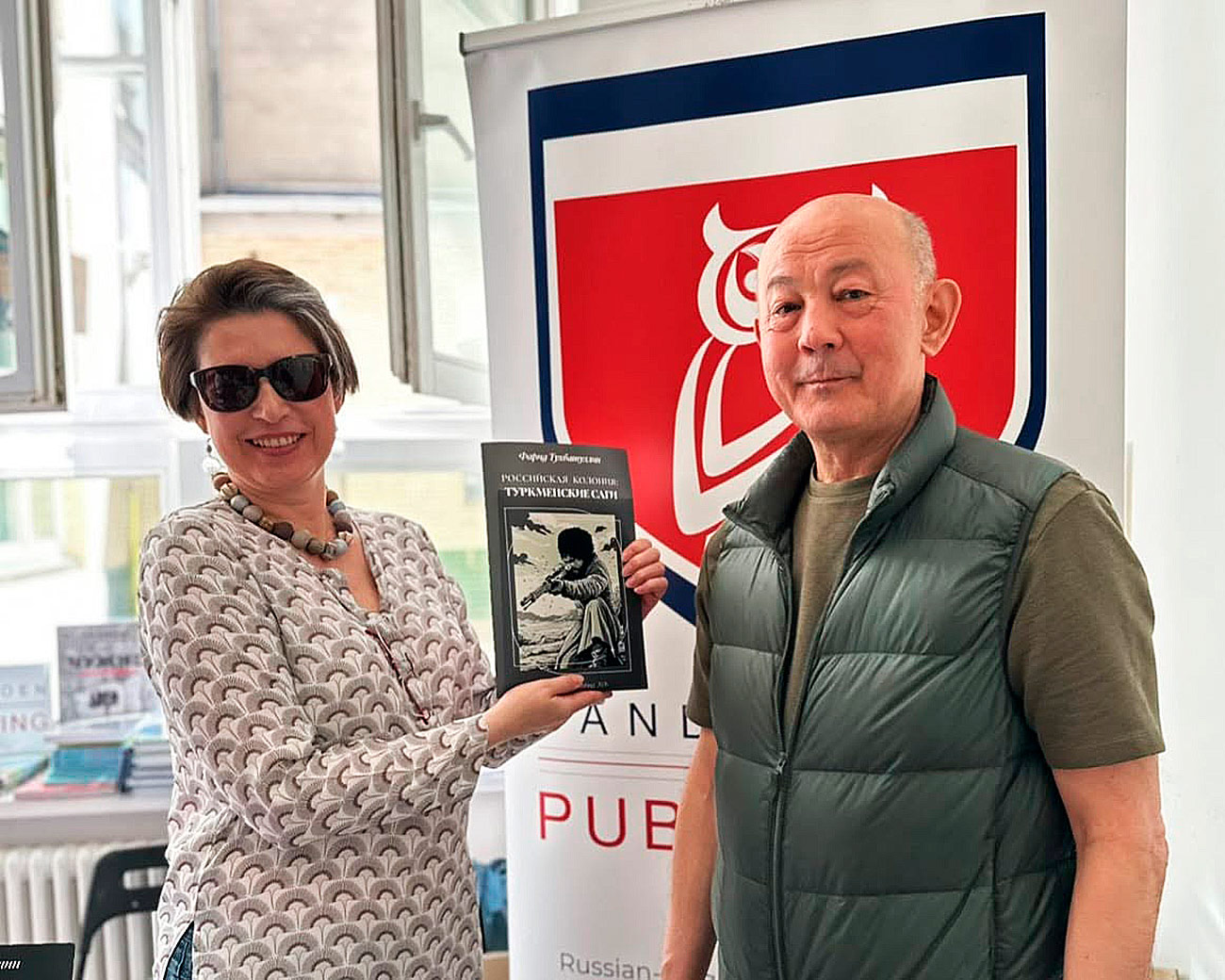 Anna Sandermoen and Farid Tukhbatullin presenting the book The Russian Colony: Turkmen Sagas. Photo from Farid Tukhbatullin's personal archive.
— Who is the publisher of your book?
— The book was published by Sandermoen Publishing, a Swiss publishing house. Its director is Anna Sandermoen, whose maiden name is Chediya. Sandermoen Publishing releases not only Russian-language books but also bilingual ones, including children's literature. These are very popular among migrants here, whose children want to learn both their native language and another, depending on where they live. Anna herself was born in Tajikistan and later lived in Kyrgyzstan, so she is no stranger to the region and truly understands what is happening in Central Asia.
I think we’ve built a very strong working relationship. We resolved ongoing issues fairly quickly, and her staff, editors, and artists efficiently guided my manuscript to its final version. The electronic version is already out, and the print edition will be available soon. From September 11 to 13, the 'Prague Book Tower' fair will take place—we plan to participate, and a presentation of my book is scheduled there.
— In the book's preface, you are described as both a human rights defender and an ecologist. This isn't the first time I've encountered this combination in Turkmenistan. Why do these roles overlap?
— Speaking personally, I am a rural dweller by origin, so nature is an organic part of my existence. But more broadly, during the early years of Niyazov's rule, registering human rights organizations was strictly forbidden, whereas ecological ones were permitted. As a result, several such environmental groups sprang up in Tashauz (now Dashoguz), Ashgabat, and Krasnovodsk. Some obtained official status, some did not, but the authorities didn't really harass them. This was immensely helpful when the secret services began tightening their grip. When traveling to meetings and conferences abroad, we introduced ourselves as ecologists, and for a while, the authorities were more or less okay with that. Perhaps that's why human rights defenders and ecologists became intertwined—two roles rolled into one.
But, for the record, we did actually work as ecologists. We collaborated with all the republics of the former USSR and other foreign partners, met frequently, and implemented real projects. Furthermore, my professional background is in hydro-reclamation engineering, so this was also an area of professional interest for me.
Overall, Turkmens traditionally live in a unique symbiosis with nature. They have inhabited these lands since time immemorial; the natural environment is quite harsh, with the Karakum Desert covering most of Turkmenistan. Natural resources were traditionally scarce. A rule emerged: when people utilized nature's gifts, they took only what they needed at that moment. If, for example, they were planning to build something, they didn't chop down everything in sight, knowing they might need it tomorrow. Why take today what I don't need today? This likely fostered a fairly careful, sustainable attitude toward nature.
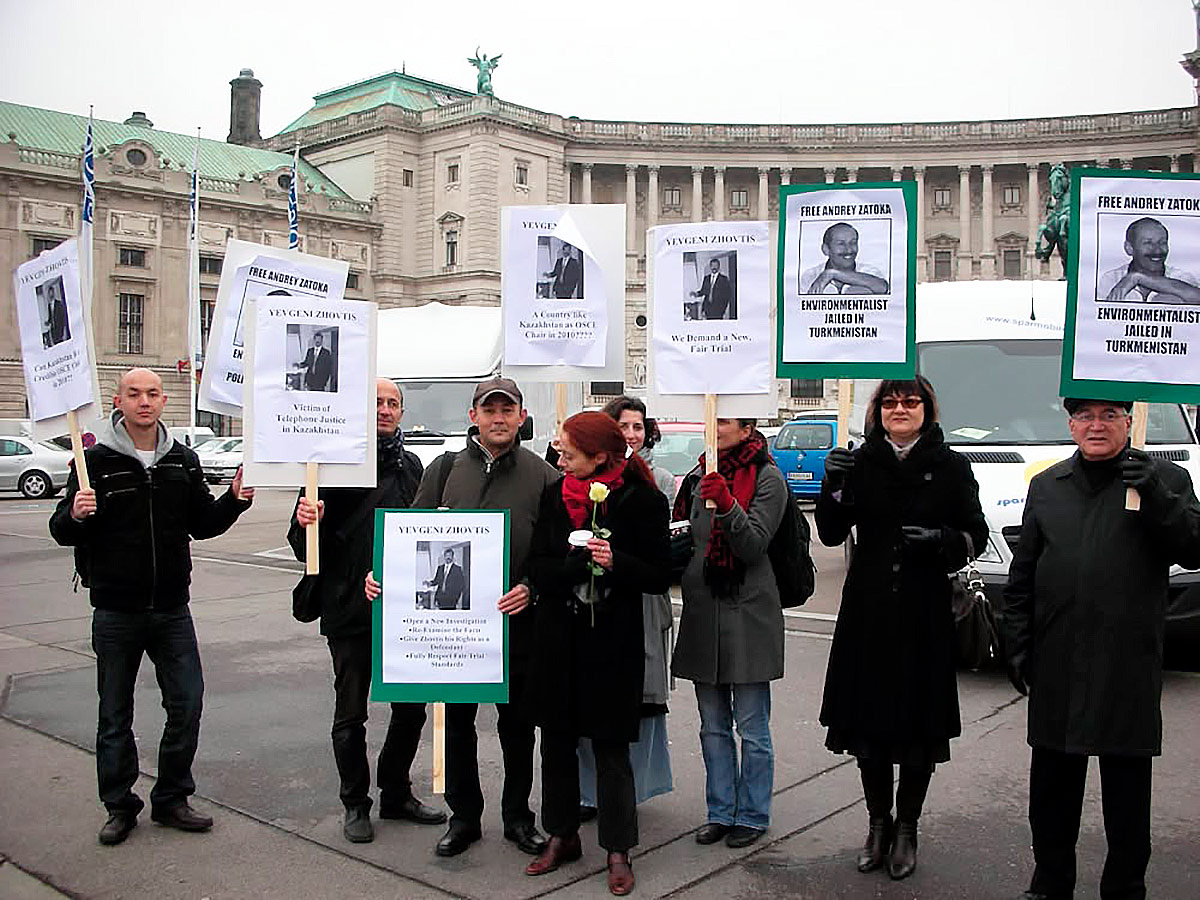 At a protest in Vienna. Farid Tukhbatullin is third from the left. Photo from his personal archive.
Though, there are nuances there, too. For example, I describe instances where people born in the sands struggled to transition to life in the city, where everything is green and there are many trees. Either way, one could always leave the city and take up animal husbandry or, conversely, return to the city for a settled life.
— The preface states the following about the Turkmens: «their descendants gained independence, but not freedom.» In your opinion, why couldn't Turkmens defend their freedom when it came to a homegrown Turkmen dictatorship? Has something changed in the people over these decades?
— Listening to the old men's stories, I got the personal impression that when Tsarist troops conquered these lands, they weren't particularly brutal. Yes, the «White Tsar's» army defeated the Turkmens in battle, and the Turkmens acknowledged their authority. Nevertheless, the Turkmens were allowed to live their own lives, even as Russians settled there. But when the Bolsheviks arrived, they started restructuring absolutely everything according to their own rules. And I believe it was those 70 years of the Bolshevik regime that broke the back of the Turkmens' love for freedom. In my book, Junaid Khan says that an empire that teaches people to obey the law is better than one that trains people merely to follow orders.
It must be said that Saparmurat Niyazov himself was a product of Bolshevism. Orphaned at a young age, he was raised in an orphanage and later schooled by the Communist Party. His methods of governance were exactly the same as under Stalin. At first, he might have wanted to rule like Brezhnev, but he eventually decided the Stalinist model suited him better. So, you have to add 15 years of Niyazov's «maximum-security regime» to the 70 years of Soviet power. Together, these years likely broke the Turkmens' spirit. This conditioning was passed down from generation to generation and is probably deeply ingrained in modern Turkmens as well.
Moreover, ordinary people have enough daily problems to worry about—unemployment, corruption, and so on. Unfortunately, people stay silent. The psychological mechanism is simple: if a boss is appointed over you, you must submit to him.
There's one more factor. Various tribes live in Turkmenistan. It's one thing to be free, so to speak, within your own tribe. It's an entirely different challenge to unite the tribes in order to make the whole nation free. That, of course, is far more difficult.
— Turkmens call themselves a nation of tribes. Is this still relevant? How much do the tribes differ, and how does this affect modern life?
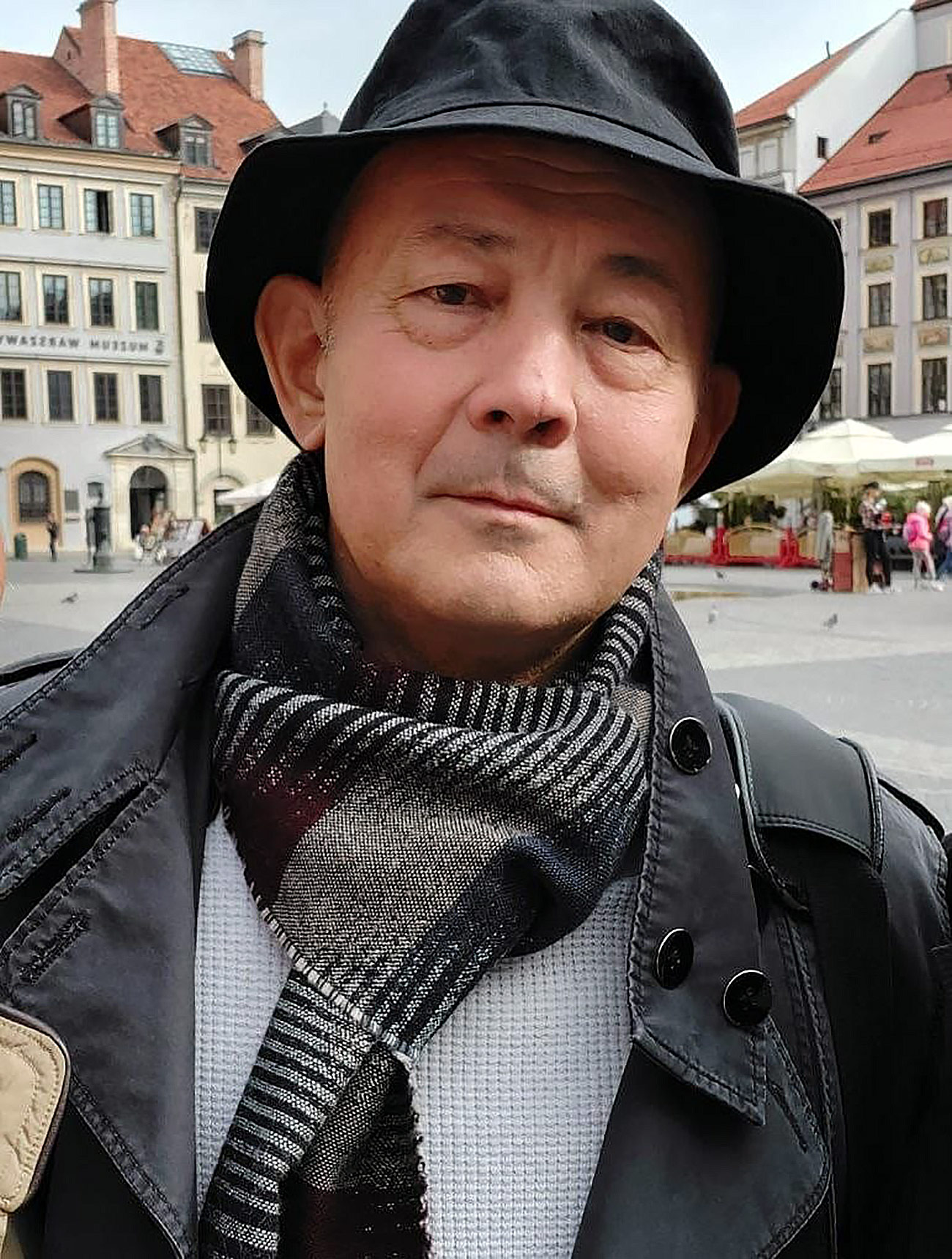 Farid Tukhbatullin. Photo from his personal archive.
— In principle, the tribal division still exists today. Perhaps not as acutely as in previous years. But, for instance, back in my youth, a classmate of mine from the Chowdur tribe fell in love with a girl from the Yomud tribe. Both sets of parents were categorically against it, but they married anyway. For many years, the parents from both sides refused to speak to each other or to the young couple. Inter-tribal marriages were not welcomed—at least, not back then.
Today, of course, things are more relaxed. Furthermore, there's active labor migration, to Turkey for example, not to mention internal migration—in those circumstances, I don't think tribal differences matter much. If anything, regional ties hold more weight than tribal affiliation.
However, tribal division has traditionally been critical when it comes to political power, even under Niyazov. True, early on, he tried to maintain a certain parity. People from different tribes and regions were appointed to high government positions. Someone from Tashauz, someone from Mary, someone from Ashgabat. But during the later Niyazov years, and certainly today, the government is predominantly controlled by the Akhal-Teke from the Teke tribe. They are the ones primarily running the country.
— In one of the stories, an ordinary woman who writes poetry makes an appearance. How common is the female poet in the Turkmen tradition?
— I remember that back in the 1960s and 70s in rural areas, it was customary to send out wedding invitations featuring a four-line poem dedicated to the newlyweds. Interestingly, it was mostly young women or girls who composed these verses. It might not have been high poetry, but the fact remains—there were women people routinely turned to specifically for poetry.
As for serious, professional poetry, I can give you two contrasting examples. We had Annasoltan Kekilova. She was a poetess who wrote verse, but she was also a dissident. She wrote exposés, criticized the Soviet government, and so forth. Ultimately, she was locked away in a psychiatric clinic, where she died in 1983 at the age of 40. Kekilova fell just short of living to see Gorbachev's Perestroika. Had events unfolded slightly differently, she might still be alive today.
But Turkmenistan also has her polar opposite. She is also a poetess, named Amangozel Shagulyeva. Born in 1940, she is alive and well today. By all appearances, she considers it her mission to glorify the government, regardless of who is in power. During the Soviet era, Shagulyeva praised the Communist Party; under Niyazov, she praised Niyazov; under Berdymukhamedov Sr., she praised him; and now she praises his son, Serdar Berdymukhamedov, dedicating odes to them for any reason or no reason at all. And she, too, is considered a poetess.
— Some historical episodes in the book are shockingly brutal—for example, the story of how Junaid Khan cut off the nose of his own daughter for disobeying her husband.
— Yes, that’s a well-known story. I am in no way justifying this cruelty, but it likely wasn't considered something extraordinarily out of the norm in those years. Today, for example, in neighboring Iran, people are publicly hanged in city squares. Thank God, we don't have that in Turkmenistan. But what happened, happened.
— Such stories certainly reek of archaic times. To what extent do modern Turkmens still cling to archaic customs? How strong are these traditions?
— I don't think you can broadly label an entire nation as either progressive or archaic. A nation isn't a single person; you have all sorts. In Russia today, for example, they are fighting for «traditional values» on a state level. At the same time, because of their semi-nomadic lifestyle, Turkmens were not as deeply steeped in Islamic ideology—at least, not in the past. They were guided by the Quran for many years, but even today, a mullah might perform incantations, cast love spells, and tell fortunes—essentially doing what people did centuries ago in pre-Islamic times. Among the people, this isn't considered particularly sinful, and they frequently seek out these services. We call such people palchy—they deal in fortune-telling, sorcery, and healing. And all of this survives to this day.
— Voices are sometimes heard claiming that in certain countries, a dictator is actually beneficial—that he will keep the populace from descending into savagery and extremism.
— But dictators come in different stripes. One might be so religious that his rule sparks a rise in fundamentalism and fuels extremist tendencies among the people.
Besides, dictators step down sooner or later. Even if a dictator passes power to his son, grandson, and so on. Just because the Turkmen president handed power to his son doesn't mean the son will be an exact carbon copy of him. The younger generation usually wants to live on its own terms, so perhaps the son will want to rule in his own way. And perhaps things will take a turn for the better.
— Still, do you think the Turkmens will manage to overcome the hereditary Berdymukhamedov autocracy?
— I think that what the Turkmens cannot overcome, time will.
* * *
-
 17 September17.09Summit of Morning FreshnessCritical minerals, artificial intelligence — what else was discussed at the “Central Asia–Korea” meeting
 -
 02 September02.09Who Are You, Mr. Vice President?From Analyst to Kazakhstan's Second-in-Command: How Erlan Karin's Views Have Evolved
 -
 01 September01.09Just Look, Don't Say You Didn't SeeAn Islamic civilization media forum in Tashkent gathered over 300 journalists from nearly 50 countries
 -
 30 August30.08The Real Intrigue Comes LaterObservers and experts assess Kazakhstan’s first elections to the new Kurultai parliament
 -
 21 August21.08Elections to a Weakened KurultaiBerit Lindeman, Secretary General of the Norwegian Helsinki Committee, on democracy and the parliamentary campaign in Kazakhstan
 -
 18 July18.07From Survivor to ActivistDina Tansari explains how Kazakhstan’s NeMolchi movement fights violence, police failures and state pressure
-
The world's tallest dam is being built in Tajikistan on empty reserves and other people's loans
-
While Emomali Rahmon receives an honorary certificate “from the UN”, the Amu Darya keeps running shallow…
-
What lies behind Kiriyenko’s visit to Uzbekistan?
-

Alisher Aminov on Italy's failure, Michel Platini, the «Iran case» and chaos at FIFA