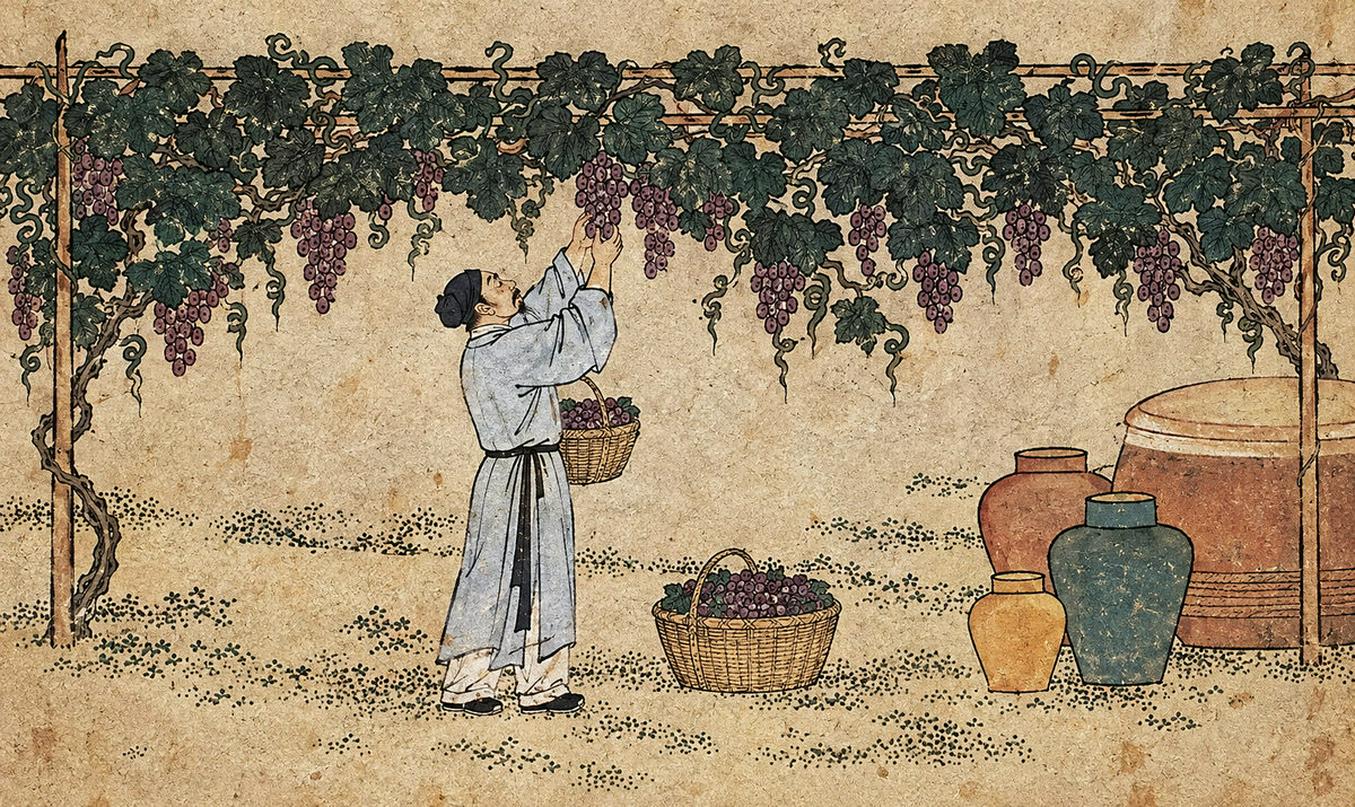
In October of this year, the 47th World Congress of Vine and Wine and the General Assembly of the International Organisation of Vine and Wine (OIV) took place. For the first time in history, the congress was held in Asia, in the Chinese city of Yinchuan. Although Beijing's bid to join the OIV was approved only in 2024, winemaking and wine appreciation in China trace their roots back thousands of years—not to mention that the country currently ranks third globally in total vineyard area.
Drunken Shrimp
Hu Xiaowei, author of «Wine Culture in China,» notes that the Chinese purchase an annual volume of alcohol comparable to 3,500 times the capacity of the famed West Lake. Statistical records show that West Lake holds 14.29 billion liters of water. Multiplied by 3,500, that yields an astronomical 50.015 trillion liters. Divided among the country's entire population, this would mean every citizen—including the elderly, infants, and pregnant women—consumes more than 35,000 liters of alcohol each year. While that figure is obviously fantastic, a look back through Chinese history explains why measuring alcohol not in liters or even cubic meters, but in entire lakes, has become a lasting trope.
The final sovereign of the Shang dynasty (c. 1600–1046 BC) was King Zhou. He earned enduring infamy as an insatiable hedonist, glutton, and drunkard. According to legend, he ordered the excavation of an artificial lake filled to the brim with wine, dotted with small islets laden with roasted meats. On these islands, naked men and women, led by King Zhou himself, abandoned themselves to unchecked debauchery—or, as the ancient Romans and certain modern politicians might put it, wild bacchanals.
To this day, the Chinese language preserves the idiom «jiu chi rou lin»—«a pool of wine and a forest of meat»—used as a metaphor for extreme decadence and moral ruin. The tradition of measuring wine by the lake likely dates back to those immemorial times.
In truth, the Chinese often prize wine even more than tea. Yet unlike tea, unrestrained indulgence in wine has frequently led to revelry, public disorder, and moral decline. Perhaps that is why historical records document at least 15 separate instances of nationwide alcohol prohibition across the millennia.
The earliest ban on alcohol dates to the reign of the legendary forefather Yu the Great, who lived more than four thousand years ago. According to one tradition, it was during his era that wine was first produced in China. Yu was celebrated for taming the catastrophic floods that had submerged the plains. Legend holds that he devoted thirteen years to combating the deluge, passing by his own doorstep three times without ever stepping inside, pouring all his energy into saving his homeland. Waiting at home were his three wives, one of whom was reputed to be a nine-tailed fox spirit. Weary of waiting, the wives asked a cook named Yi Di to find a way to coax Yu back home—if only for a brief moment.
Yi Di devised a solution: he concocted wine and presented it to Yu. The ruler drank one goblet, then immediately downed another. Reinvigorated by the vintage, Yu grew merry, his body flushed with vigor and his spirits lifted. It is said that in his gratitude, he even promised his daughter's hand to Yi Di. Upon sober reflection, however, Yu concluded that wine brought far more harm than good and promptly outlawed it. Thus began the first prohibition in Chinese history.
Despite such ancient austerity, visitors to Shaoxing, home to Yu's official tomb, can always sample a delightful local vintage alongside a traditional delicacy known as «Shaoxing Little Drunkard,» which is typically made of shrimp.
Indeed, wine features prominently in a vast array of Chinese dishes, none more famous than drunken shrimp and drunken crab. Many connoisseurs consider Hangzhou the undisputed capital of these culinary specialties. Live freshwater shrimp (or small crabs) are placed into a marinade of Shaoxing wine and fragrant spices. Intoxicated by the alcohol, they begin to leap and thrash inside a dedicated clear glass vessel sealed with a heavy lid. The bowl is brought tableside so diners can watch the frantic, tipsy spectacle. As the alcohol takes full effect, the crustaceans gradually calm down and drift into a drunken stupor. Only then is the lid lifted, and the feast begins.
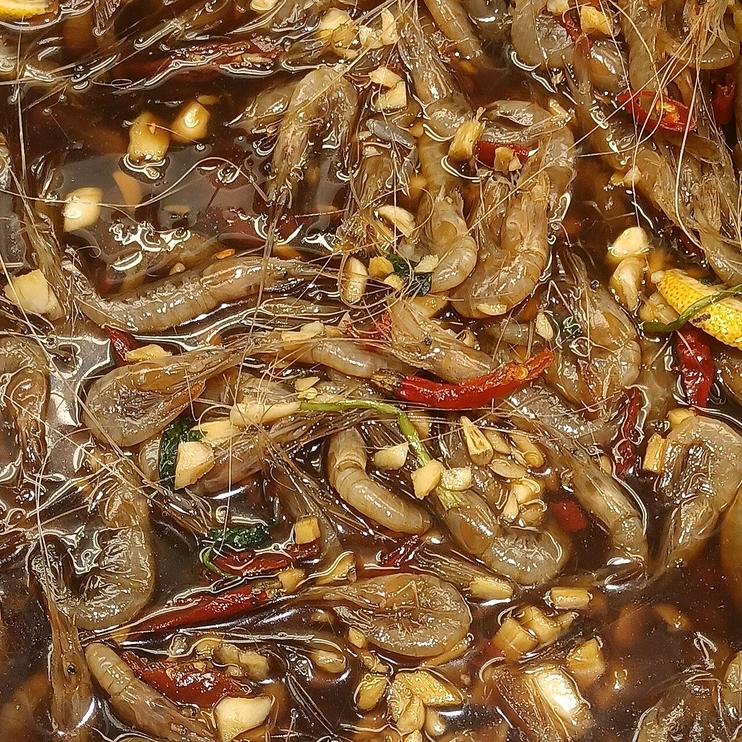 «Drunken shrimp,» a traditional Chinese appetizer prepared with alcohol. Photo: Fumikas Sagisavas / Wikimedia Commons, CC0.
Monkey Vintners
Mainstream archaeology, however, challenges the legend of Yu the Great. Chinese scholars believe that alcohol emerged in the region long before the mythic ruler, dating its origins to roughly 7000–5500 BC. That timeline rests on excavations carried out in 1983 in the small settlement of Jiahu, Henan province, where archaeologists unearthed what remain the world's oldest known chemical residues of fermented beverages.
Chemical analysis of the Jiahu pottery sherds revealed that the vessels once held a fermented brew of wild grapes, hawthorn fruit, honey, and rice.
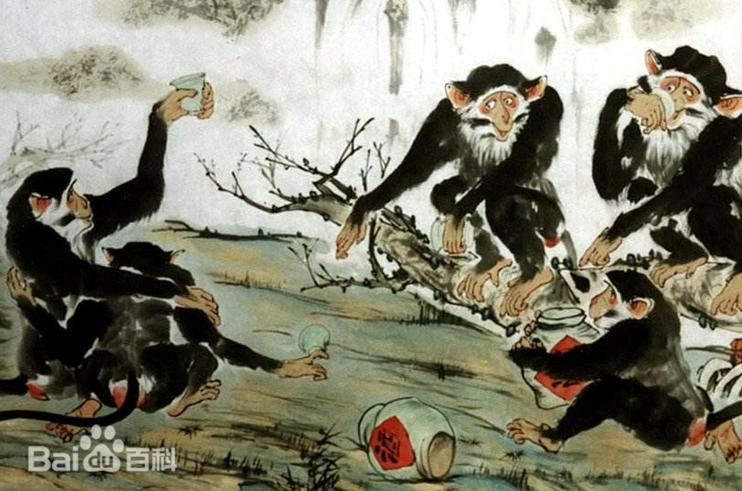
Some Chinese researchers have ventured even further back, arguing that the true pioneers of fermentation were monkeys—native Chinese primates, naturally. According to this folklore, these resourceful apes inhabited Mount Huangshan, gathering wild fruit and stashing it in rock crevices. Heated by the sun and fermented by wild ambient yeasts, the fruit broke down into an intoxicating nectar that pooled in natural stone basins. The monkeys would gather to drink the mash together. Once sated, the normally aggressive, territorial primates grew docile and affectionate. A competing version credits primates in Qianzhou on Hainan Island with discovering the brew. Sorting through these competing regional claims, however, is a challenge few humans—or monkeys—could untangle today.
Returning to Yu the Great and his cook Yi Di, the chef went down in lore not only as the inventor of wine, but also as the proprietor of China's first tavern. Yu's prohibition applied strictly to senior court officials; the ruling elite cared little about commoners, whose standing in the imperial hierarchy was scarcely higher than that of primates. Yi Di quickly realized that forbidden fruit could yield handsome profits and opened a drinking den catering to lower-tier bureaucrats and ordinary citizens. Situated where the city of Baofeng stands today, the establishment reportedly did brisk business.
In time, the imperial ban on grape wine was lifted, and emperors and high-ranking courtiers returned to savoring fine vintages. That era also gave rise to a ruthless custom: if an emperor was presented with a wine he disliked, the vineyard vines from which it was pressed were uprooted on the spot.
Grapes from Fergana
One historical school of thought holds that China owes its true viticulture to the Fergana Valley—specifically, to the ancient Central Asian kingdom of Dayuan. It was from there that the imperial envoy and explorer Zhang Qian brought prime cuttings of European wine grapes back to the imperial capital in 138 BC. Prior to his expedition, China cultivated only native «mountain grapes,» which yielded rough, inferior wines.
Persian viticultural expertise, transmitted eastward through the oasis settlements of Xinjiang, soon taught Chinese vintners how to properly tend domestic vines and press refined vintages.
By the Tang dynasty (618–907), wine had achieved immense popularity; over those three centuries, more than a hundred distinct styles emerged. Imperial wineries flourished alongside private ventures run by mandarins and ordinary citizens alike.
Under the succeeding Song dynasty (960–1279), the wine industry experienced sharp boom-and-bust cycles, swinging wildly between state-sponsored consumption and draconian crackdowns, to the immense frustration of local imbibers.
A fresh chapter in the saga of Chinese viticulture opened with the rise of the Mongol-led Yuan dynasty (1271–1368). The Mongol conquerors developed an immediate fondness for Chinese grape wine, and the khans became devoted patrons. It was during the Yuan period that offering grape wine to spirits during major temple sacrifices became an established ritual. Around the same time, the first truly expansive commercial vineyards were planted in Shanxi and Jiangsu provinces.
By the Qing dynasty (1644–1911), grape wine was broadly classified as a foreign luxury known as «yangjiu» («overseas liquor»). While favored by the imperial court, it remained almost entirely out of reach for commoners—who, in any case, showed little enthusiasm for its unfamiliar, unpalatable taste.
Champagne met with a similarly lukewarm reception. Chinese palates never fully warmed to sparkling wine, perhaps put off by the carbonation. Although China's last emperor, Puyi, and its first president, Yuan Shikai, were both keen admirers of Champagne, the public rejected the Western indulgence. Domestic imitations popped up in major cities in the early 2000s, but they bore only the faintest resemblance to authentic Champagne, drawing bewilderment from foreign expatriates.
Following the 1911 Revolution and the turmoil of the ensuing civil wars, refined viticulture took a back seat as the population turned to simpler, cheaper spirits. In the latter half of the 20th century, however, industrial alcohol production skyrocketed. In 1949, when the Communists took power and founded the People's Republic of China, annual national output stood at 100 million liters of distilled spirits, 70 million liters of beer, and just 200,000 liters of grape wine. By 2008, China was churning out 5.69 billion liters of spirits, 41.03 billion liters of beer, and 700 million liters of wine.
During the 1960s, imports of Bulgarian, Hungarian, and Soviet vintages entered China, shaping a preference among older Chinese drinkers that closely mirrors post-Soviet tastes. Beijing sent its first delegation to an OIV conference in 1979, yet China secured full membership in the organization only in 2025.
72 Degrees Proof
Today, China's primary winemaking regions are clustered in northern provinces such as Hebei and Shandong. Some historians suggest this northern concentration took root because Islam historically entered China from the south, particularly through the port of Guangzhou, and Islamic dietary laws forbid alcohol. Although substantial Muslim communities now reside in the north as well, the historical precedent held, cementing the north as China's viticultural heartland. One of the country's largest estates sits on the outskirts of Beijing, anchored by a European-style château that hosts major international wine conferences.
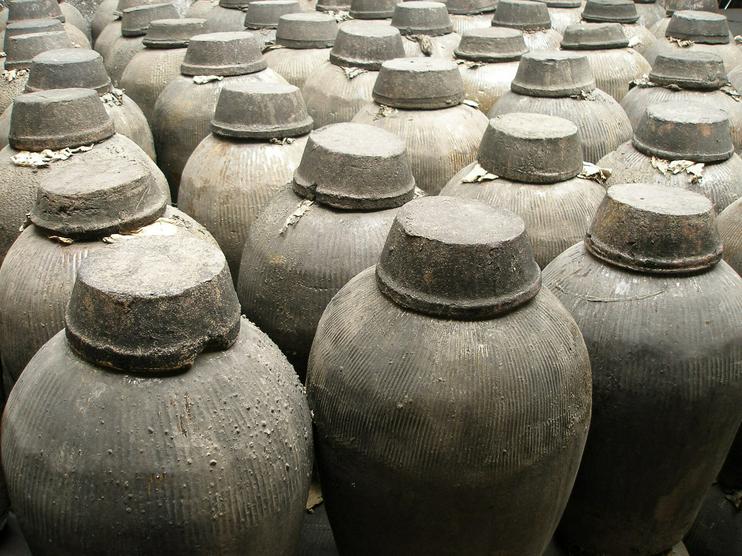 Rice wine aging in ceramic jars, China, 2006. Photo: Benjamin Chan / Wikimedia Commons, CC BY-SA 2.0.
With mountains and high plateaus covering much of the country, high-altitude viticulture has also found a home here. China's loftiest vineyard sits 2,700 meters above sea level in the Tibetan village of Yanjing («Salt Well»). The plots were planted in the 1860s by a French Catholic missionary. At the time, foreign entry into Tibet carried the death penalty, with exceptions granted only to merchants. The resourceful cleric disguised himself as a trader, slipped into the region to preach Christianity, and brought with him Bordeaux cuttings alongside traditional French winemaking techniques. He erected Tibet's first and only Catholic parish, which stands to this day. A local community of Tibetan Catholics tends the plots, producing a modest 150 liters of wine each year.
Yet wine is hardly the only drink of choice. The Chinese consume vast quantities of distilled spirits, beer, and other fermented liquors. Most of these beverages incorporate the character 酒 («jiu»), an umbrella term for all alcoholic drinks. The word's origins trace back to an ancient era when libations offered to the gods consisted not of alcohol, but of pristine spring water known as xuanjiu (玄酒)—«dark, mysterious, primordial wine."
In modern usage, qualifiers are prefixed to specify the beverage: 葡萄酒 (putaojiu) for grape wine, 白酒 (baijiu) for clear grain spirits, 啤酒 (pijiu) for beer, and so on.
No discussion of Chinese drinking culture is complete without noting the national passion for high-proof spirits, chiefly baijiu. These traditional distillates are generally far stronger than Western spirits, fermented and distilled from sorghum, millet, wheat, or barley. A standard 40-percent Western spirit is considered mild by comparison. The most popular baijiu brands hover around 52 to 53 percent alcohol by volume, including the prestigious Kweichow Moutai. Others climb past 60 percent, with some reaching as high as 70 or 72 percent.
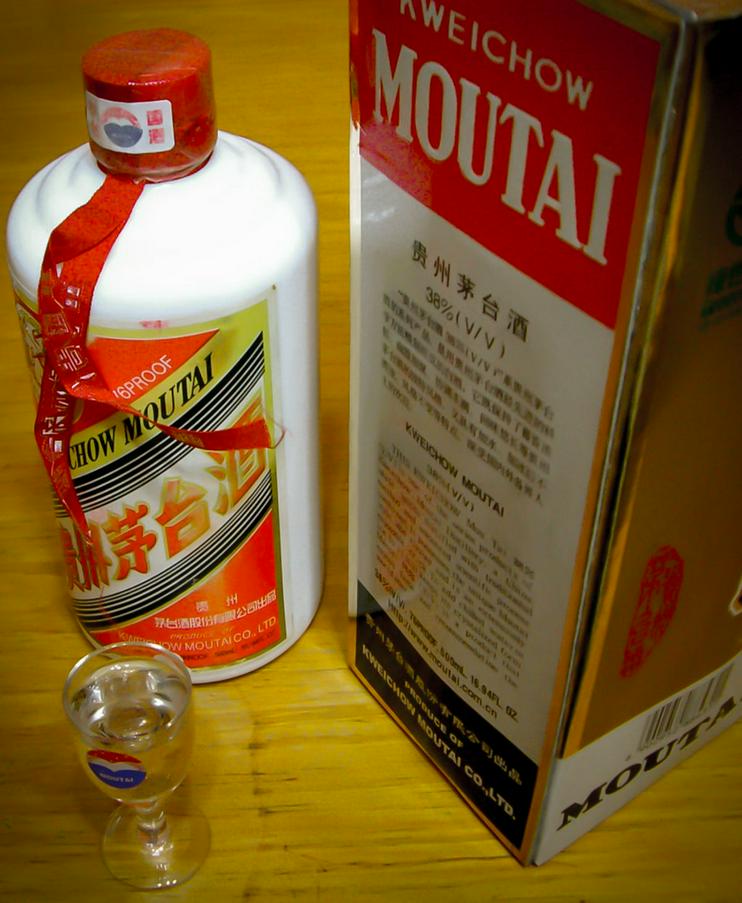 A bottle of Moutai, China's premier baijiu spirit. Photo: Javierpetrucci / Wikimedia Commons, CC BY-SA 4.0.
In 2026, China implemented a new national standard (GB/T 48009-2026) that permits baijiu to range from 18 to 72 percent ABV. Navigating these fiery gradations is an art mostly left to domestic connoisseurs. Given the pungent, savory profiles of most traditional baijiu, many foreign palates find them notoriously difficult to acquire.
Drunk for Three Years
Naturally, the Chinese pantheon includes a patron deity of brewing: Du Kang. According to lore, he ruled during the Xia dynasty, roughly a century after Yu the Great. As the story goes, Du Kang placed leftover cooked rice inside a hollow mulberry trunk; passing by some time later, he caught a fragrant aroma wafting from the bark. That fermented mash yielded the first wine, and Du Kang was subsequently revered as the protector of brewers and wine merchants.
A well-known proverb celebrates his craft: «Drink Du Kang's brew, and you'll stay drunk for three years.» Henan province still produces a spirit branded as Du Kang Jiu; in 1988, China's Ministry of Foreign Affairs designated it an official banquet drink for visiting dignitaries.
The story of Chinese alcohol would be incomplete without its medicinal dimensions. Warmed wine infused with botanicals is repeatedly cited in the classical pharmacopeia «Shennong's Herbal Classic.» Large traditional pharmacies continue to operate throughout the country, preparing remedies from blends of herbs, minerals, bat extracts, deer antler, seahorses, and scorpions. Neighboring these apothecary shops are modest stalls lined with outsized glass carboys filled with therapeutic tinctures, most often steeped in rice wine. After consulting a practitioner, patients can stop by for a supplemental tonic, purchased by the shot or bottled in three-liter jugs.
In downtown Hangzhou, one specialty shop features giant glass jars containing snakes preserved in clear liquor—ranging from small pit vipers to immense pythons that peer menacingly through the glass at prospective buyers. Imbibing these snake-infused elixirs is widely believed to invigorate the body and ward off ailments.
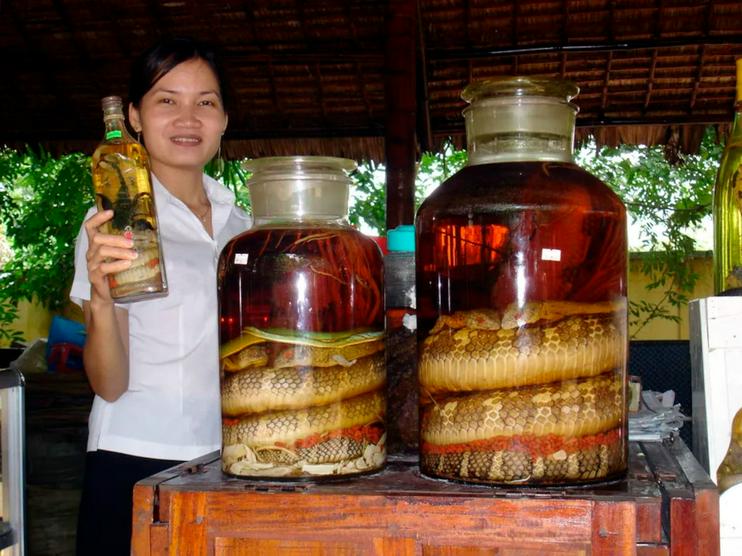 In China, wines and spirits are steeped not only with small venomous snakes, but with full-grown pythons. Photo: Fergana.agency
Given this cultural reverence, it is hardly surprising that China boasts numerous museums devoted to the craft of fermentation. The most celebrated are nestled near Shanghai in historic water towns that draw steady streams of tourists. After wandering through medieval canal quarters, visitors enter exhibition halls where they can inspect towering fermentation vats and sample their contents. Many facilities stage costumed reenactments showing how premodern artisans stoked furnace fires under copper cauldrons and calligraphers decorated earthenware jugs. Guests are invited to sample dozens of local varieties, dipped from vats with small wooden ladles into porcelain cups. The pours may be modest, but with tasting menus frequently featuring up to fifty styles, a visitor's sobriety is tested solely by stamina and pocketbook.
-
 01 October01.10Yields of 6–7 Tonnes per HectareUzbekistan is expanding a Chinese cotton-growing method to a third of its cotton fields
-
 01 September01.09Just Look, Don't Say You Didn't SeeAn Islamic civilization media forum in Tashkent gathered over 300 journalists from nearly 50 countries
-
 21 August21.08Elections to a Weakened KurultaiBerit Lindeman, Secretary General of the Norwegian Helsinki Committee, on democracy and the parliamentary campaign in Kazakhstan
-
 10 August10.08A Caravan in the Expanse of the UniverseHuman rights defender and journalist Farid Tukhbatullin on the past, present, and future of the Turkmen people
-
 05 February05.02The “Guardian” of Old Tashkent Has Passed AwayRenowned local historian and popularizer of Uzbekistan’s history Boris Anatolyevich Golender dies
-
 24 December24.12To Clean Up and to ZIYAWhat China Can Offer Central Asia in the “Green” Economy
-
Uzbek filmmaker Rashid Malikov on his new film, a medieval threat, and the wages of filmmakers
-
What has Samarkand accomplished in its three thousand years of existence?
-

Damir Mukhetdinov on the Center for Islamic Civilization in Tashkent, the Kaaba Covering, and Qurans
-
Photo Tour of the Fergana Valley with Anzor Bukharsky