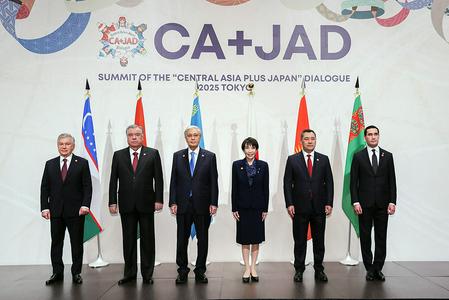
Shavkat Mirziyoyev. Photo: Press service of the President of Uzbekistan
Uzbekistan expects rapid growth in IT, artificial intelligence and Internet-of-Things projects in the coming years, including the development of supercomputing clusters and large data centers. These initiatives are projected to increase national electricity demand by at least 1.5 times. In response, President Shavkat Mirziyoyev has identified five strategic priorities for the country’s energy sector, his press service reported.
First, to meet rising domestic demand, Uzbekistan will introduce more than 17,000 megawatts of renewable-energy capacity by 2030. As a result, the share of “green” energy is expected to reach 54 percent. To integrate these new facilities into the national grid, the government plans to build 6,000 kilometers of high-voltage transmission lines, including 1,000 kilometers next year along with substations totaling 6,000 MW.
Second, the government will expand foreign investment in the sector through public-private partnerships. This approach now applies not only to electricity generation but also to distribution. An agreement has already been reached with Turkey’s Aksa Elektrik to transfer Samarkand’s regional power networks to private management. Foreign partners will also help modernize the system, with reduced losses expected to save up to $20 million annually. Similar initiatives will be launched in Jizzakh and Syrdarya next year and in Namangan and Tashkent regions in 2027.
Third, the government will intensify support for the transition to alternative energy. In 2026, solar stations with a total capacity of 107 megawatts will be installed across 300 mahallas (local communities) through cooperative projects. This will supply 30,000 households with green energy and allow them to sell surplus electricity back to the grid. Entrepreneurs have already built small and micro hydropower plants totaling 40 MW this year, generating 120 million kilowatt-hours of electricity and providing additional income — a program that will continue.
Fourth, at the COP-30 climate conference in Brazil, Uzbekistan committed to reducing greenhouse-gas emissions by 50 percent by 2035. The government has begun implementing the iCRAFT project with the World Bank, which has accounted for 23 million tons of reduced emissions, and has launched the sale of carbon credits on the international market. This year alone, 17 major industrial enterprises adopted international green-energy certification standards, with the number expected to reach 100 soon.
Fifth, Uzbekistan is expanding regional cooperation to advance a unified energy market. Mirziyoyev announced that financing will soon begin for the Kambarata-1 hydropower project, developed jointly with Kazakhstan and Kyrgyzstan. He also highlighted the efforts of Azerbaijan and Kazakhstan to establish a “green corridor” for electricity exports to Europe.
“Through such determined steps, we will undoubtedly build a modern, next-generation energy system,” Mirziyoyev said.