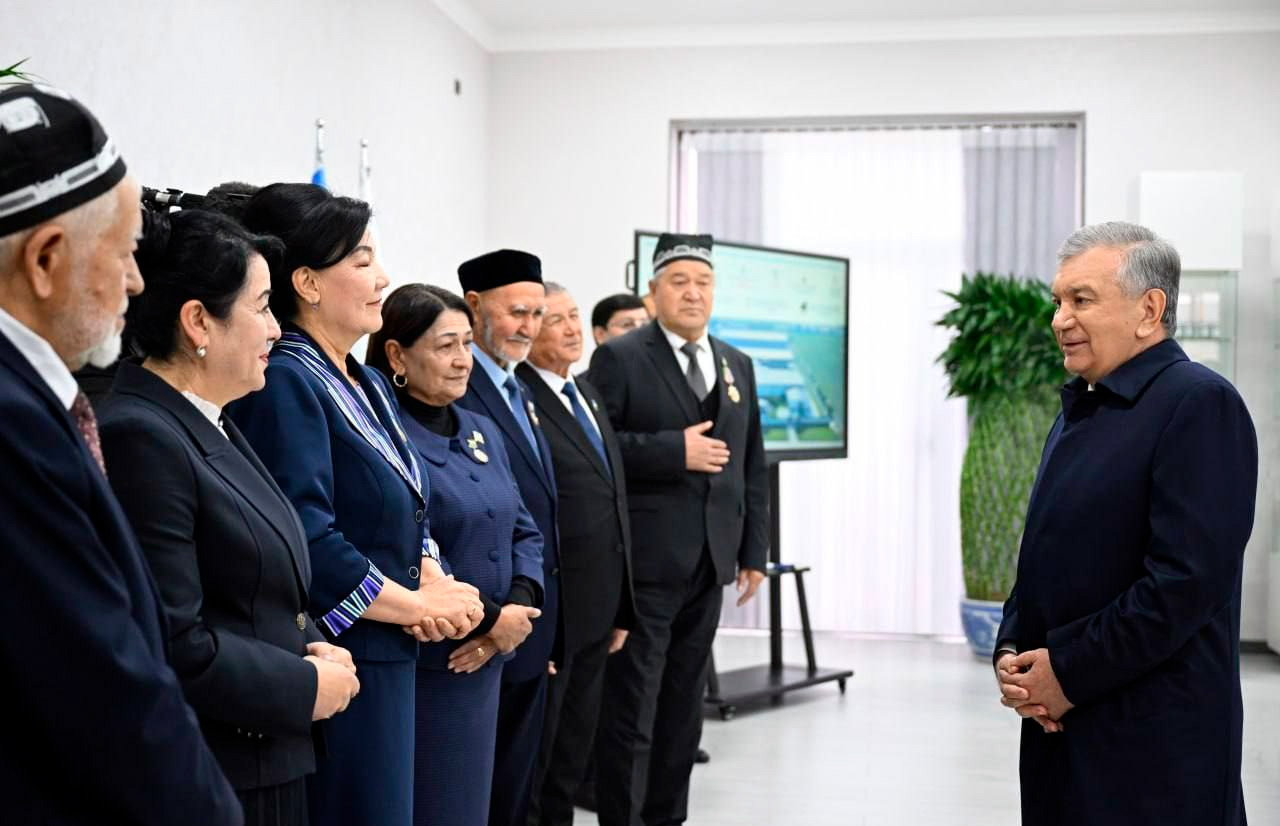
 Shavkat Mirziyoyev meeting with farmers in Syrdarya. Photo: Press Service of the President of Uzbekistan
For 27 years, cotton production in Uzbekistan was conducted without a scientific approach, causing people to suffer in the fields. President Shavkat Mirziyoyev made this statement during a meeting with farmers in the Syrdarya region on December 4, Gazeta.uz reported, citing a segment from the Uzbekistan 24 television channel.
“It turns out that our lives were wasted on cotton. For 27 years we suffered. All of us saw this cotton scourge in the fields, and there were no results. There was no science, no experience; without knowledge we simply shouted ‘hurrah-hurrah.’ Everyone was driven into the fields, and people were given neither money nor equipment, and scholars were not respected. And we could not even harvest 25 centners [per hectare] in the Syrdarya region. Most importantly, the cotton we grew did not even cover our costs,” Mirziyoyev said.
As a contrast, the president highlighted current yields. He spoke of a farmer from Jizzakh who harvested 85 centners per hectare. At the Syrdarya meeting, a local farmer reported achieving 76 centners of cotton of variety “87,” calling it a miracle. According to him, people have developed a strong interest in their work because they have begun to earn real income from their labor. Mirziyoyev asked what income Uzbekistan might have earned if cotton growers had been harvesting 50 centners per hectare.
The president emphasized that the country is now moving in the right direction but that improvements are still needed. For 2026, Uzbekistan has set a target of procuring 4.5 million tons of raw cotton. For comparison, in 2025 the country harvested 3.765 million tons.
To improve efficiency in the cotton sector, a mentorship system has been proposed, pairing experienced farmers with yields above 60 centners with colleagues who are lagging behind. Mentors will undergo training and receive certificates, and if their trainees reach yields of 50 centners per hectare, the mentors will receive a bonus of 5 million soums ($417).
ℹ️ Forced cotton harvesting in Uzbekistan was practiced for decades — both during Soviet times and after the country gained independence, under President Islam Karimov (1991–2016). Each year, employees of public and private institutions, as well as students and schoolchildren, were sent en masse to the fields. In the mid-2000s, the international coalition Cotton Campaign launched the Uzbek Cotton Pledge, joined by about 300 apparel brands that pledged not to use Uzbek cotton until forced labor was eliminated.
The situation changed after Shavkat Mirziyoyev came to power. During Karimov’s rule, he served as prime minister for 13 years (2003–2016). The authorities ended the mass mobilization of the population for cotton picking and stopped involving schoolchildren. Cotton production lost its former centrality but remains important. In March 2022, Cotton Campaign lifted its boycott of Uzbek cotton. Later that autumn, the United States removed Uzbek cotton from its list of goods produced with child or forced labor.
The current leadership of Uzbekistan aims to generate revenue not from selling raw cotton, as in the past, but from exporting finished textile products with added value. In 2017, only 40 percent of cotton fiber was processed domestically; today that figure is 100 percent. Moreover, Uzbekistan will now import cotton, including from the United States.