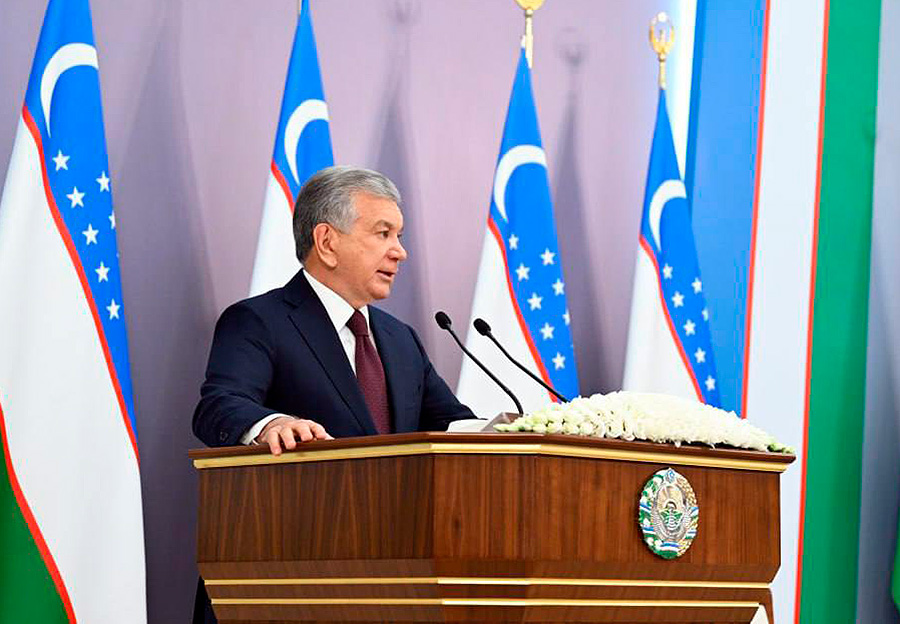
 Shavkat Mirziyoyev. Photo courtesy of the press service of the President of Uzbekistan.
President Shavkat Mirziyoyev has ordered a review of Uzbekistan’s Defense Doctrine and National Security Concept in response to changes in the nature of global threats, the presidential press service reported.
Speaking on January 13 at an expanded meeting of the Security Council devoted to strengthening the country’s defense capacity, Mirziyoyev said that regional conflicts are expanding worldwide and the arms race is intensifying. He noted a growing erosion of respect for universal values and international law, arguing that under such conditions approaches to national security require a fundamental overhaul.
“The key point to understand is that the nature of modern warfare has changed radically. Anyone who believes victory can be achieved solely through the number of tanks, aircraft, or troops is deeply mistaken,” the president said. “Today’s wars are fought on the basis of artificial intelligence, digital command and control, long-range precision strike capabilities, cyber and robotic technologies, as well as political and economic pressure.”
These shifts, Mirziyoyev said, necessitate a revision of the country’s core strategic documents. The current Defense Doctrine was adopted eight years ago and requires updating. The National Security Concept is even more outdated, having been approved in 1997. The president instructed that both documents be brought into line with contemporary realities.
The revised doctrine is to reaffirm Uzbekistan’s non-aligned status and its commitment not to join any military blocs. The country will continue to rely on multilateral diplomacy, while the development of the armed forces will be based on high technologies and the principle of military self-reliance.
The new doctrine should serve as the foundation for technological modernization of the military. Mirziyoyev emphasized the need to introduce advanced military solutions, with particular attention to equipping troops with robotic systems and unmanned platforms.
To preserve peace, all sectors must shift to a “proactive mode of operation,” he said—anticipating potential risks and threats rather than responding after the fact. In the context of digitalization, cybersecurity assumes special importance.
Officials were tasked with defining a set of measures to protect personal data and digital systems, as well as strengthening the resilience of the national digital infrastructure. Training specialists capable of countering information attacks was identified as a priority.
The president noted that in recent years the armed forces have already adopted new tactical approaches. The number of military exercises has increased by one and a half times, and dedicated unmanned aerial vehicle units have been created. However, the rapidly evolving security environment, he said, requires further strengthening of the country’s military-scientific base.