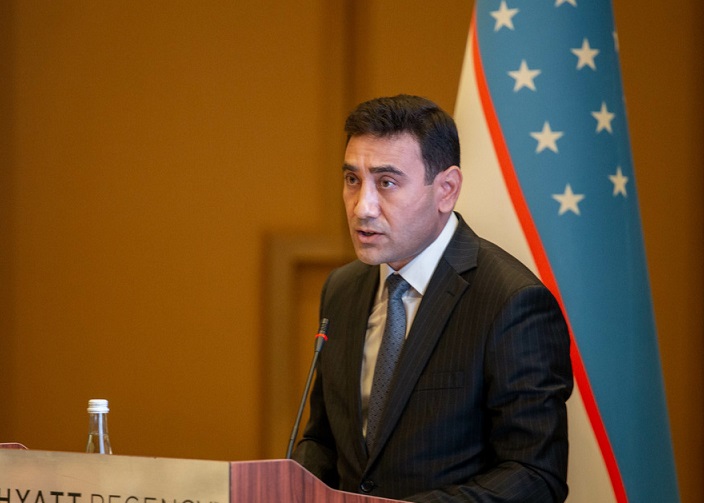
 Akmalhon Ortikov. Photo: press service of the State Assets Management Agency.
President of Uzbekistan Shavkat Mirziyoyev has sharply criticized the work of fiscal and law enforcement bodies responsible for overseeing the movement of budget funds in large state companies, announcing the dismissal of senior officials in the tax service and the State Assets Management Agency, according to the presidential press service.
As part of the review, Deputy Chairman of the State Tax Committee Mubina Mirzayeva and Director of the State Assets Management Agency (SAMA) Akmalhon Ortikov were removed from their posts.
Addressing corruption within government institutions, the president said inspections of Uzbekneftegaz and SAMA had uncovered embezzlement totaling billions of sums. In one case, officials from the agency reportedly put a land plot valued at no less than 250 billion sums (about $20.6 million) up for a closed auction and sold it for 120 billion sums (about $9.9 million).
Ortikov was dismissed over these violations.
“If corruption flourished in these agencies for many years, the question arises: where were those responsible for security oversight?” the president said.
Mirziyoyev instructed the head of the State Security Service, Bahodir Kurbanov, to examine the responsibility of officers who supervised the activities of Uzbekneftegaz and the State Assets Management Agency.
The president also pointed to serious violations in tax administration. He said cases of budget funds being stolen through artificially inflated value-added tax (VAT) refunds had become more frequent. Last year, criminal cases were opened against 20 tax inspectors over незаконное возмещение НДС (illegal VAT refunds).
As a result, the first deputy chairman of the State Tax Committee, Mubina Mirzayeva, who oversaw this area, was dismissed.
The situation in Tashkent was described as particularly troubling. The shadow economy there has reached an estimated 60 trillion sums (about $4.9 billion), leading to annual budget losses of 7.5 trillion sums (about $619 million).
According to the president, excise taxpayers conceal production and sales volumes, reducing fiscal revenues, while city tax inspectors perform poorly. About 30,000 VAT payers paid nothing into the budget, and cash registers are not used in roughly a quarter of retail and service outlets.
Some tax officials, Mirziyoyev said, actively shield businesses. He noted that last week the head of the Mirzo-Ulugbek district tax inspectorate, Dilshod Usmanov, was dismissed and charged in a criminal case. Investigators allege he rented out part of the inspectorate’s building and pocketed 315 million sums (about $26,000), and was also involved in embezzlement and an organized criminal group.
Tax discipline has also not been enforced at the Chorsu and Malika markets in Tashkent. Of 1,500 entrepreneurs operating there, only about a quarter are registered; many do not pay taxes and conceal revenue. At the same time, tax authorities have reportedly met their targets by overcharging compliant businesses: more than 876 billion sums (about $72.3 million) were collected in excess from over 46,000 organizations.
In light of these issues, the president ordered the dismissal of Yunusjon Nasimjanov, head of the Tashkent State Tax Department, and Khojiakbar Mullajonov, head of the Shaykhantahur district tax inspectorate, and instructed authorities to review their activities in accordance with the rule of law.
He also ordered the immediate removal of Ganiev, a deputy head of the city department of the Prosecutor General’s Office, for allegedly assisting businesses in tax evasion. Finally, Mirziyoyev directed the chairman of the State Tax Committee, Farrukh Pulatov, to dismiss all district tax chiefs in Tashkent, reappointing them only in an acting capacity pending further review.