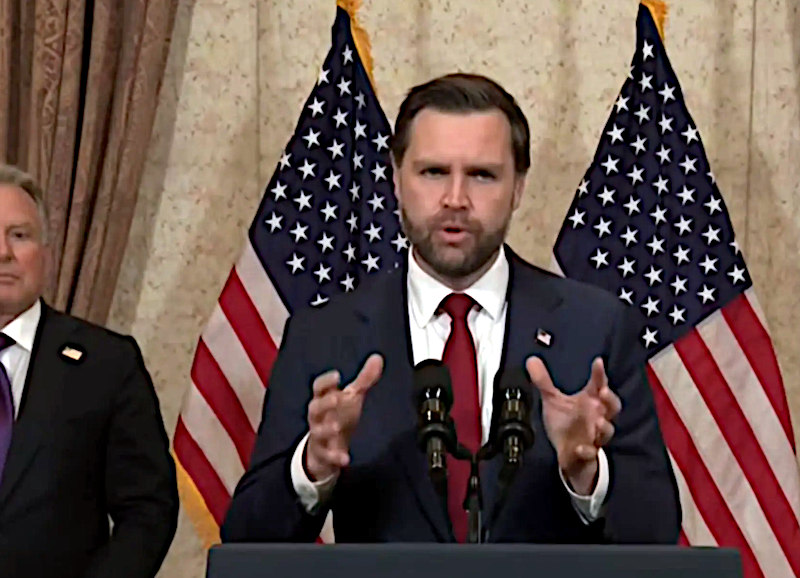
 Vance in Pakistán. CNN
U.S.-Iran talks held April 11–12 in Islamabad, Pakistan, concluded without any agreement. Vice President JD Vance, who led the American delegation, spent a total of 21 hours at the negotiating table before announcing his departure for home «without a deal.»
At a final press conference in the Pakistani capital, Vance said the two sides had held «a number of substantive discussions» but described the outcome as «bad news, first and foremost for Iran.»
«We made our red lines clear. They chose not to accept our terms. We are going home without an agreement,» he said. According to Vance, Washington's key demand remained a «clear and unconditional commitment» from Tehran to neither develop nuclear weapons nor acquire the technologies needed for their rapid production. The United States also insisted on the immediate and full reopening of the Strait of Hormuz.
Iran responded to the breakdown in its characteristic fashion. The press service of the Iranian Embassy in Ghana posted a sardonic message on social media: «The U.S. sent its Vice President to the other side of the world — to Islamabad. Twenty-one hours of talks. They demanded everything they failed to achieve through war. Iran said NO. The talks are over. The Strait remains closed. And the Vice President is flying home empty-handed.»
Iran's Foreign Ministry spokesman Esmail Baghaei was more measured, saying the talks had taken place «in an atmosphere of mutual distrust» and that the parties had found common ground on several issues, while diverging on two or three fundamental points.
The Islamabad talks represented the first attempt to convert a fragile two-week ceasefire — declared on April 8 — into a durable peace agreement. The ceasefire had been reached barely an hour before the expiration of an American ultimatum in which President Trump threatened strikes against Iranian bridges and power plants. During the conflict, which began in late February, the United States and Israel struck Iranian nuclear facilities and killed Supreme Leader Ali Khamenei. In response, Iran blocked the Strait of Hormuz, through which roughly 20 percent of the world's oil and gas supplies pass.
Following the collapse of the talks, Donald Trump strongly hinted at the possibility of a naval blockade of Iran, sharing on social media an article headlined «Trump's Trump Card: If Iran Won't Yield — a Naval Blockade.» The authors argued that a blockade would allow the United States to assert full control over the Strait of Hormuz and pressure Iran's main oil buyers — chiefly China and India. Three supertankers did pass through the strait on Sunday morning, but it effectively remains closed: Iran is demanding coordination with the Islamic Revolutionary Guard Corps and has indicated the presence of naval mines.
▫️The future of the negotiations remains unclear. Pakistan, which served as mediator at the Islamabad meeting, urged both sides to uphold the ceasefire and expressed readiness to continue facilitating dialogue. Iran signalled it was «in no hurry»: the Tasnim news agency, citing informed sources, reported that no changes to the situation in the Strait of Hormuz should be expected until a «reasonable deal» is reached on Tehran's terms. Israeli Prime Minister Benjamin Netanyahu, meanwhile, declared that the war with Iran «is not yet over.»