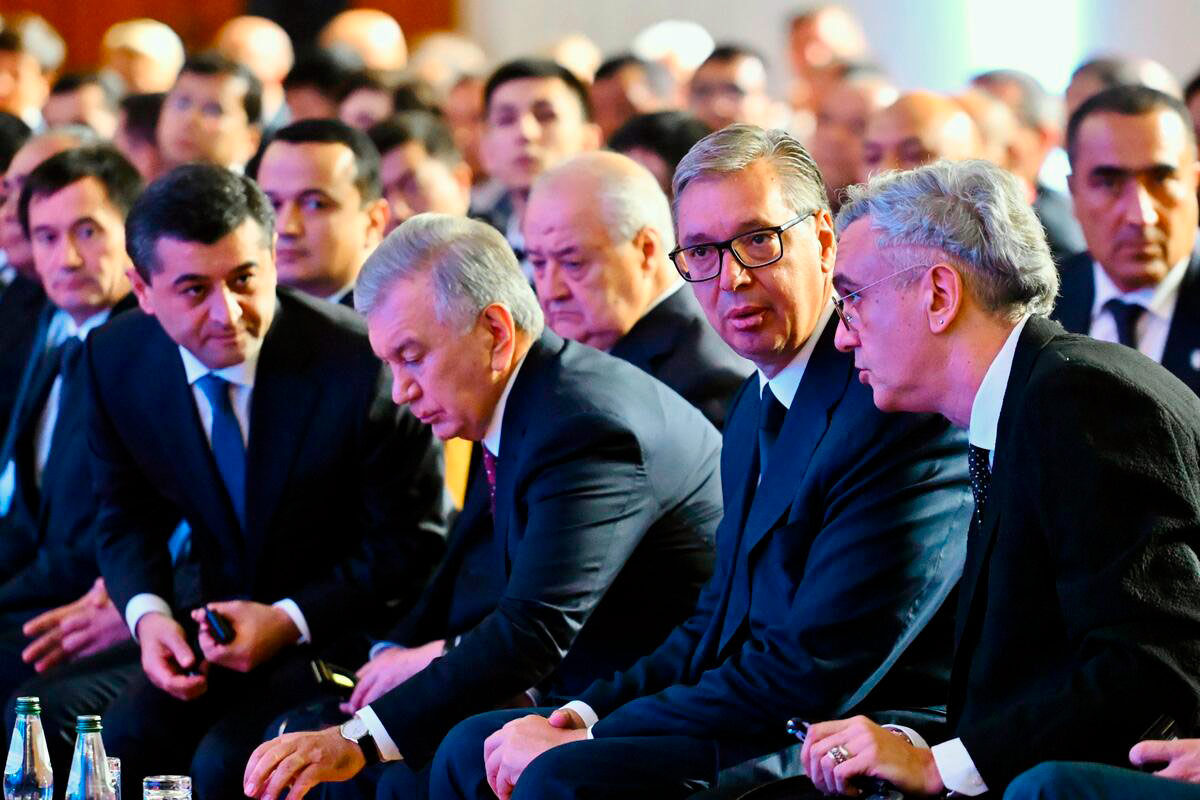
 Aleksandar Vučić (second from right), Shavkat Mirziyoyev and other officials. Photo from kurir.rs
Uzbekistan will build its second nuclear power plant jointly with Chinese partners, Serbian President Aleksandar Vučić has said.
Vučić made the statement on September 8 in Belgrade at a business forum attended by representatives of the two countries’ business communities.
“I asked President Mirziyoyev this morning during our one-on-one meeting, and he told me: ‘I am building one nuclear plant with the Russians and the second with the Chinese, but that is not enough for me. Before I finish this, I will continue building. I will continue working,’” according to a transcript of Vučić’s speech published by Kurir.rs.
China has thus been named for the first time as a participant in the construction of Uzbekistan’s second nuclear power plant. In mid-August, Mirziyoyev announced that another nuclear facility would be built in the country, but did not identify the prospective foreign partner.
Discussing Uzbekistan’s energy strategy, Vučić said Mirziyoyev was planning ahead for the country’s future power needs, including demand generated by data centers, artificial-intelligence systems, innovation and electric vehicles. The Serbian president praised Uzbekistan’s approach to expanding generating capacity, arguing that European countries should also prepare for rising electricity consumption.
Uzbekistan is implementing its first nuclear project with Russia in the Farish district of the Jizzakh region. The plant will include two VVER-1000 reactors, each with a capacity of 1 GW, and two RITM-200N small modular reactors, each with a capacity of 55 MW.
The technical launch of the first small reactor is expected in October or November 2029, followed by the second six months later. The first large power unit is scheduled to enter service in 2033, while full construction is expected to be completed in 2034–2035.
The first nuclear power plant will have total installed capacity of 2,110 MW and could generate up to 17 billion kWh annually. The project’s base cost is estimated at about $9.5 billion.
The official parameters of the second nuclear project, including its capacity, location, construction schedule and cost, have not yet been disclosed.