The space for human rights defenders to work safely in Tajikistan has shrunk over the past two decades to such an extent that the very survival of the country's once-vibrant human rights community is now under threat, according to a report by the Brussels-based organization International Partnership for Human Rights (IPHR), «On Unsteady Ground: Human Rights Defenders in Tajikistan», published in September 2026.
The 37-page document is based on years of observation and more than two dozen interviews with human rights defenders from urban and rural areas of Tajikistan, conducted in 2025. The authors trace how, starting in 2007, the authorities began introducing restrictions on groups working on electoral rights, religious freedom, and the rights of national minorities, and how from the mid-2010s pressure sharply intensified amid the crackdown on the political opposition — the IRPT party, banned and labeled extremist in 2015. It was then that lawyers defending party members were arrested, including lawyer Buzurgmehr Yorov, who is still serving a sentence in a case initiated, according to human rights defenders, in retaliation for his statements about the torture of his clients.
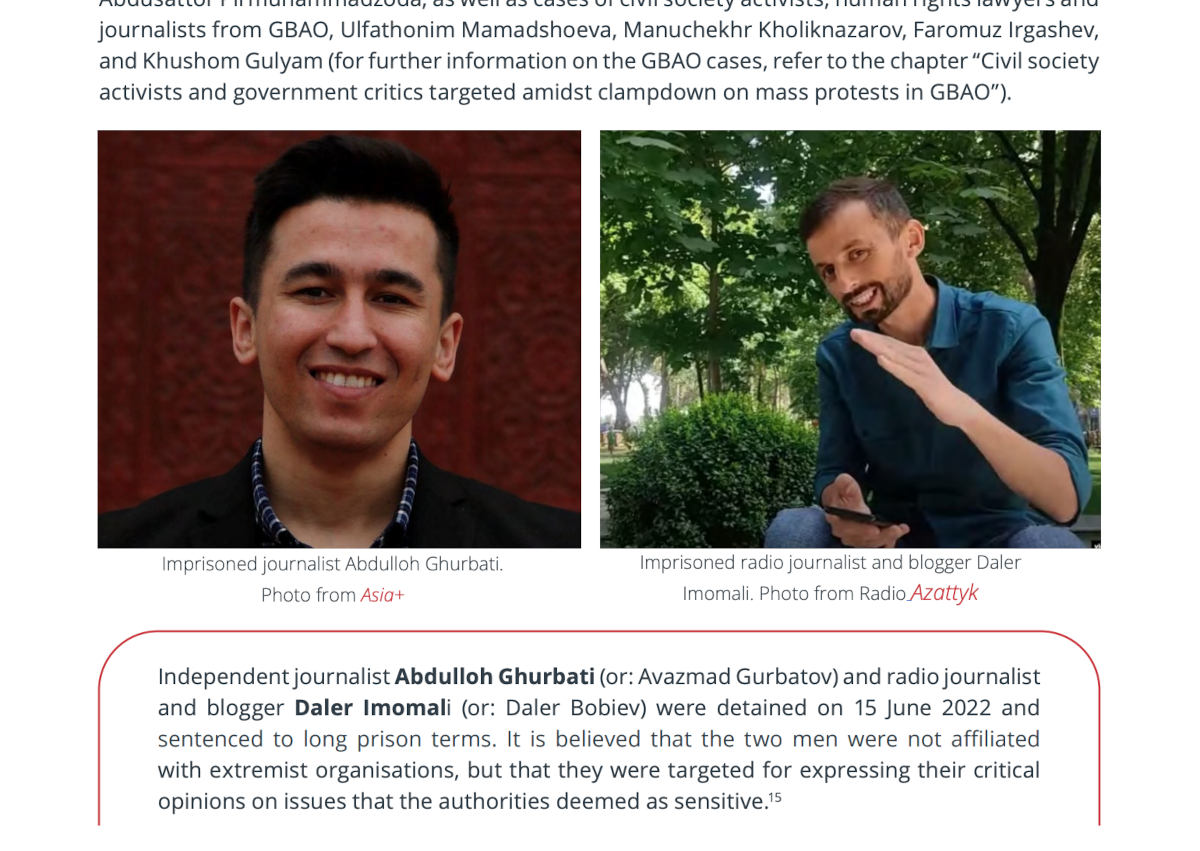
According to the report's authors, pressure on independent journalists and bloggers has also sharply intensified over the past decade: dozens of the country's most experienced editors have left Tajikistan, and those who remain are forced to practice self-censorship. Among those convicted on charges of extremism, incitement of hatred, or treason, the report names journalists Abdulloh Ghurbati, Daler Imomali, Khurshed Fozilov, Akhmad Ibrohim, and Rukhshona Khakimova, who was sentenced in February 2025 to eight years for treason in connection with her reporting on China's influence in Tajikistan.
A separate chapter is devoted to the violent suppression of protests in the Gorno-Badakhshan Autonomous Region (GBAO) in 2021 and 2022, when, by the authors' estimate, at least 40 people were killed; in the aftermath, members of «Commission 44», set up to investigate the events, were arrested, including human rights lawyer Manuchehr Kholiqnazarov, who was sentenced to 16 years in prison and later awarded the international Martin Ennals Award.
The report also documents the systemic narrowing of legal space for civil society: between 2021 and 2022, most NGOs in GBAO shut down, and today only 35 organizations remain registered there, fewer than ten of which work to protect vulnerable groups. Across the country, another 85 NGOs ceased operations in 2025, and from October 1 of that year, state fees for registering public associations were sharply increased. Funding is a separate problem: a January 2025 decree suspending U.S. assistance to Tajikistan hit organizations working with HIV-positive women, victims of domestic violence, and the LGBT community, and according to an unpublished survey by the Nota Bene foundation, 22 of 38 surveyed NGOs depended on donors from the United States.
The report's authors link the weakening of international pressure on Dushanbe to broader geopolitical shifts — Russia's full-scale invasion of Ukraine, the United States' retreat from promoting human rights, and China's growing presence in the region. Despite this, IPHR calls on the international community not to lose access to the expertise of Tajik human rights defenders, to demand the unconditional release of political prisoners — including Kholiqnazarov and Yorov — and to insist that the new law on nonprofit organizations comply with international standards rather than strengthen state control.