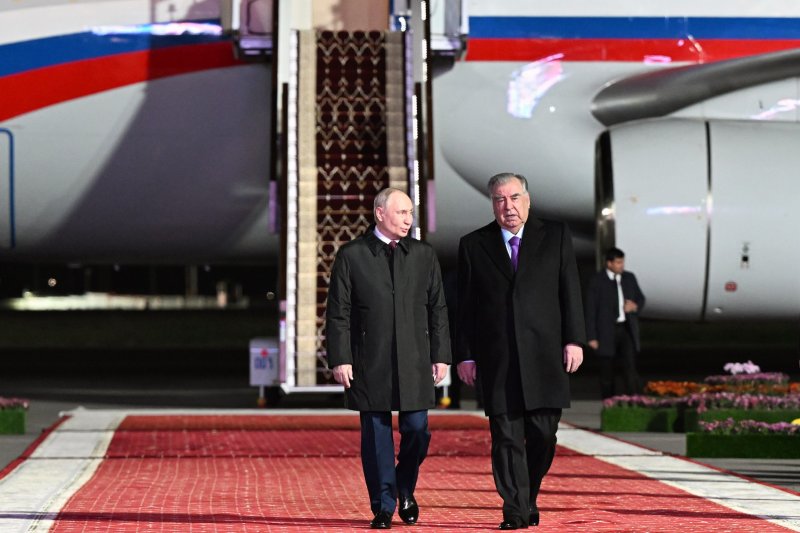
 Vladimir Putin and Emomali Rahmon. Photo via khovar.tj
Russian President Vladimir Putin arrived in Dushanbe from China on November 20, fresh off talks with U.S. President Donald Trump and Chinese President Xi Jinping. Tajik President Emomali Rahmon welcomed him at the airport. Key agenda items include cooperation on Afghanistan, regional security, and the future operations of Russia's military base in the Central Asian nation, state news agency Khovar reported.
On November 18–19, Putin attended the Asia-Pacific Economic Cooperation (APEC) summit in Shenzhen, China. On the final day of his trip, he held bilateral talks with Trump, followed by the first trilateral summit of Russian, U.S., and Chinese leaders. The three nations concluded the meeting by adopting a joint declaration on peace, affirming their commitment to international security and strategic stability.
The negotiations unfolded against the backdrop of discussions over a potential settlement to the war in Ukraine. On November 14, The Washington Post reported that Moscow's demands included a complete halt to NATO military activity not only in Ukraine and Eastern Europe, but also across the South Caucasus and Central Asia.
Moscow's proposed terms directly affect Central Asian states where Russia already maintains military installations. The largest among them is the 201st Military Base in Tajikistan. Ahead of his arrival in Dushanbe, Putin described the facility as an essential guarantor of regional stability and signaled his intention to discuss its continued operations with Rahmon.
Afghanistan will serve as another central topic. Putin plans to brief Rahmon on the November 12 visit to Kabul by a Russian government delegation led by Deputy Prime Minister Alexei Overchuk. According to Moscow, officials signed 11 letters of intent for contracts worth roughly $169 million, covering trade, agriculture, pharmaceuticals, and energy. Bilateral trade between Russia and Afghanistan more than doubled in the first eight months of 2026, topping $349 million.
Moscow's deepening ties with Kabul hold direct implications for Tajikistan, which shares an extensive border with Afghanistan. However, the two allies take divergent approaches: in July 2025, Russia became the first country to officially recognize the Taliban government, whereas Dushanbe maintains a cautious stance and continues to advocate for an inclusive Afghan administration.
Beyond security, the two leaders plan to review trade, economic cooperation, and joint ventures. Russia remains one of Tajikistan's primary commercial partners, with bilateral trade reaching $2.47 billion in 2025. Labor migration also underpins relations: hundreds of thousands of Tajik citizens work in Russia, and remittances from abroad provide vital support to the republic's economy.
Putin last visited Tajikistan in October 2025, when both nations signed 16 cooperation agreements, including a joint declaration on deepening their strategic partnership and alliance, alongside pacts on migration, security, transportation, and trade.
Established in 2004 on the foundation of a Soviet-era motorized rifle division, the 201st Military Base stations units in Dushanbe and Bokhtar. Under an agreement signed in October 2012, Russian forces are authorized to remain stationed in Tajikistan through at least 2042.