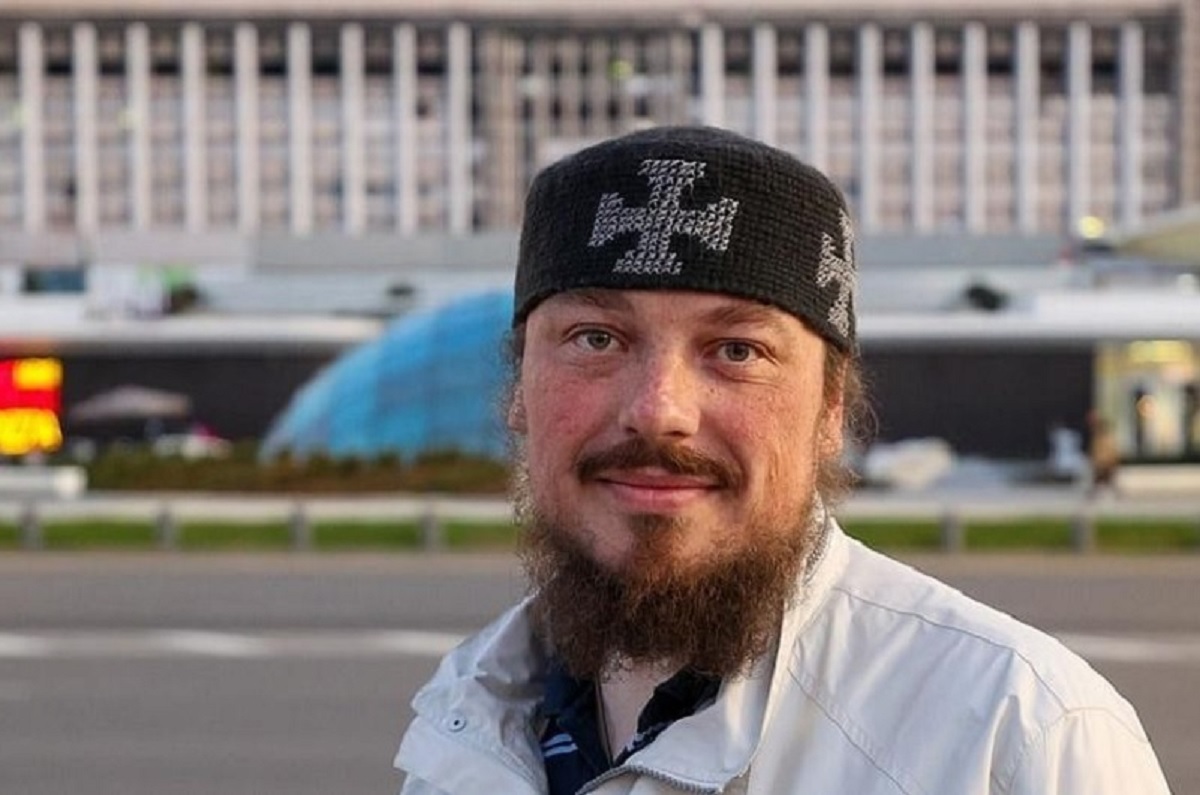
 Iakov Vorontsov. Photo from kaztag.kz
Iakov Vorontsov — born Vladimir Yuryevich Vorontsov — is a native of Kazakhstan and a former hieromonk of the Astana and Almaty diocese of the Russian Orthodox Church. He is one of the few ROC clerics who, from the very first days, openly condemned Russia’s “special military operation” in Ukraine, after which he was excommunicated and eventually became a defendant in a criminal case.
Vorontsov is currently being held in a pre-trial detention center. His two-month detention is set to expire at the end of April and will most likely be extended. More about the story of the former ROC priest can be found in this report by Fergana.
“Rebel” and “schismatic”
After the start of the “special military operation,” Vorontsov did not limit himself to silence or vague wording, as most ROC clergy did. He publicly called for Kazakhstan to withdraw from the CSTO, described Russia as an aggressor, and urged to “distance itself in every possible way” from it. He also signed a collective appeal by several hundred ROC clergy calling for peace.
“After that, the first conflicts within the Church began — they tried to persuade him, suspended him from service, sent him into exile, but he did not change his position,” Bes.media quoted a certain Geniyat, a close friend of the priest, as saying.
In August 2023, the ROC suspended Iakov Vorontsov from conducting religious services.
Shortly before that, Vorontsov announced that he himself was ceasing his service in the Russian Orthodox Church, citing years of harassment by the church leadership. He published a Facebook post in which he called the ROC “the most vile of all earthly religions,” specifying that this was “not about hatred or Russophobia, but a reaction to fascism.” This post later became the basis for criminal prosecution.
In April 2024, for “serious canonical offenses,” Iakov was defrocked.
Parallel to the church sanctions, state pressure also began. In December 2023, Kazakh authorities opened a criminal case against Vorontsov under an article on inciting national, social, or religious discord — triggered by a complaint from an Orthodox parishioner in Almaty regarding that same Facebook post.
Vorontsov appealed to Kazakhstan’s president, Kassym-Jomart Tokayev, claiming that representatives of the ROC’s Kazakh diocese were involved in the pressure against him. The metropolitan district категорically denied these accusations and refused to comment further. In May 2025, the investigation was closed due to lack of evidence of a crime.
Anti-war rhetoric was not the only source of disagreement between the former priest and the ROC. Iakov Vorontsov had many questions about the church hierarchy and the lack of independence of the metropolitan district. In this regard, he announced plans to create an Orthodox church in Almaty that would not be subordinate to Moscow.
After the first criminal case was closed, Vorontsov intensified his efforts in this direction, prompting a sharply negative reaction from the ROC.
“Orthodox believers cannot support the mentally unsound initiatives of Iakov Vorontsov. Signing statements about the creation of a new ‘church’ is unequivocally regarded as participation in a schism,” the information department of the Kazakh metropolitan district stated.
The Drug Den Case
Vorontsov made several attempts to register a new religious association with the Ministry of Justice, but was denied each time. This past winter, on February 10, the former priest tried to challenge the decision in court, arguing that the refusal was unlawful.
Three days later, on the night of February 12–13, security forces broke into Vorontsov’s apartment, conducted a search, and took him to a temporary detention facility.
Police reported that “powdery substances” were seized from Vorontsov, and a medical examination allegedly confirmed drug use. Based on a protocol for “use of narcotic substances,” he was arrested for ten days.
Vorontsov denied his guilt and, in a letter from detention published by his lawyer, stated that the court made its decision “on the basis of erroneous expert conclusions.” The former priest insisted that the drugs had been planted on him “for the purpose of retaliation and discrediting.”
On February 23, when his administrative arrest expired, Vorontsov was not released. Instead, he was immediately taken in for questioning and charged under two articles of the Criminal Code of Kazakhstan: Article 302 (maintaining a drug den) and Article 296 (possession of narcotics without intent to distribute).
“There has never been any kind of drug den in my home. My like-minded people and fellow believers came to me for conversations and prayer. The powder found in the house does not belong to me. I believe it was planted to retaliate against me and discredit me,” Vorontsov wrote from the pre-trial detention center.
On February 24, a court in Almaty ordered the former hieromonk held in custody for two months. His detention is set to expire at the end of April, but, as his lawyer Galym Nurpeisov told Fergana, it will be extended because a number of expert examinations in the case have not yet been completed.
Immediately after the arrest, Nurpeisov filed an appeal against the court’s decision to detain his client, but it was rejected. At the same time, another complaint by the lawyer — regarding ill-treatment of the former priest in the detention facility — was upheld.
It emerged that upon arrival at the detention center, Vorontsov’s beard was shaved and his hair cut against his will, and his Bible and prayer book were confiscated.
“After [my] complaint, the prosecutor’s office intervened. The officer who handled the intake at the detention facility was disciplined,” Nurpeisov said.
According to him, Vorontsov is now “treated with respect” in the detention center. “No one bothers him; there is currently no psychological pressure,” the lawyer noted.
Until recently, the Russian Orthodox Church had not commented on the case of its former priest. Only in April did the Kazakh metropolitan district, represented by Archpriest Alexander Suvorov, confirm that it was “aware” of the criminal prosecution of Vorontsov, while categorically rejecting “any claims of pressure by church structures on law enforcement agencies.” All such allegations were described as “defamatory.”
Human rights defenders insist that Vorontsov is being persecuted precisely because of his religious beliefs. In the United States, the former priest has been included in a list of victims of violations of religious freedom, according to Kazakhstan’s Bureau for Human Rights. The list is compiled by the U.S. Commission on International Religious Freedom (USCIRF).
“In February 2026, authorities arrested Vorontsov, a priest of an unregistered Orthodox church, during a nighttime search of his home. Vorontsov was a vocal critic of Russia’s war against Ukraine, stating that it has nothing to do with Christianity,” the USCIRF said in a statement.
-
 14 October14.10Digital DependenceYandex Data Center Attacks Expose Kazakhstan's Digital Vulnerability
 -
 30 August30.08The Real Intrigue Comes LaterObservers and experts assess Kazakhstan’s first elections to the new Kurultai parliament
 -
 21 August21.08Elections to a Weakened KurultaiBerit Lindeman, Secretary General of the Norwegian Helsinki Committee, on democracy and the parliamentary campaign in Kazakhstan
 -
 18 July18.07From Survivor to ActivistDina Tansari explains how Kazakhstan’s NeMolchi movement fights violence, police failures and state pressure
 -
 30 September30.09When Sea Becomes Fact of the PastWhy Tokayev Is Concerned About the Health of the World’s Largest Enclosed Body of Water
 -
 25 June25.06VideoAn Uzbek firstTashkent sends troops to Russia’s Victory Day Parade for the first time. There they took part alongside their neighbours
-
For Putin’s CIS colleagues, extending one’s rule through constitutional amendments is an old trick
-
Annual campaign against domestic violence takes place in Kazakhstan
-
Kazakhstan celebrates its Independence Day
-
What matters more to Kazakhstan: friendship with the “great neighbour” or human rights?