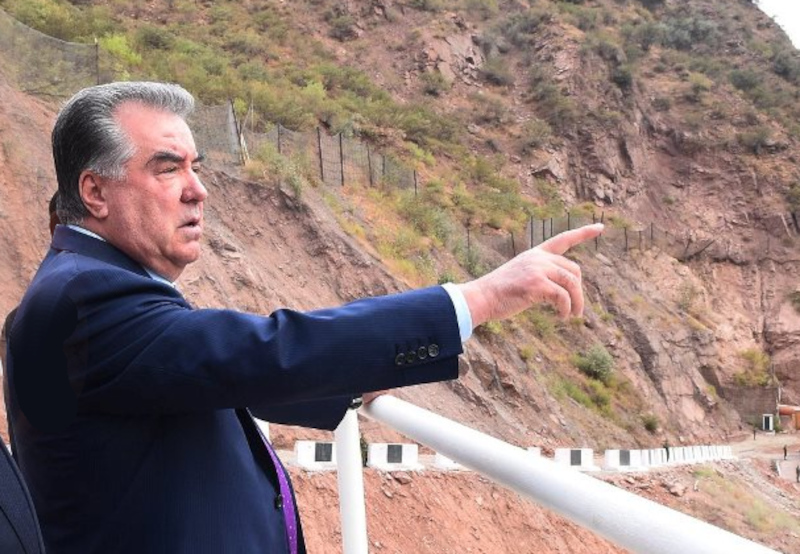
 Photo caption: Emomali Rahmon at the construction site of the Rogun Hydropower Plant
On 25 May 2026, two events took place in Dushanbe that official reports presented as links in one chain: the President of Tajikistan Emomali Rahmon received a Certificate of Recognition from the UN-mandated University for Peace (UPEACE) for his contribution to the climate agenda and regional cooperation, and the 4th International Conference on the Water for Sustainable Development 2018–2028 Decade of Action opened in the Tajik capital, bringing together more than 2,500 delegates from UN member states. Both events reinforced the image of Tajikistan as a regional leader in “water diplomacy”. At the same time, environmental organisations and independent experts continue to document risks that call this image seriously into question.
It is worth clarifying first what exactly was awarded to President Rahmon. The University for Peace (UPEACE) is an institution headquartered in Costa Rica that was established by a resolution of the UN General Assembly in 1980. Despite its UN mandate, it is an independent academic institution rather than an intergovernmental body with norm‑setting or oversight powers. The certificate was approved by an order of UPEACE Rector Francisco Rojas Aravena on 19 May 2026 and presented by the university’s Permanent Observer, Ambassador David Fernandez Puyana – in essence, this is the decision of a single person, the head of an academic institution. Neither the UN Secretariat, nor the General Assembly, nor any specialised UN agencies took part in awarding this distinction.
The wording “certificate of the UN University for Peace” that Tajik official media actively use creates a persistent – and misleading – impression of the Tajik president’s merits being recognised at the highest international level by the entire UN system.
According to the official report by the Khovar news agency, Rahmon’s specific achievements included the signing in March 2025 of an agreement on the junction point of the state borders of Tajikistan, Kyrgyzstan and Uzbekistan, the adoption of the Khujand Declaration of Eternal Friendship, the promotion of initiatives to preserve glaciers and freshwater resources, as well as an active role in implementing the International Decade of Action “Water for Sustainable Development”. Border settlement as such is undoubtedly a positive achievement that has removed a long‑standing point of tension in the region. However, attributing an environmental dimension to this diplomatic success, let alone using it to shape the image of a “climate leader”, requires closer scrutiny against the facts.
The central environmental risk associated with Tajikistan in the region is the construction of the Rogun Hydropower Plant on the Vakhsh River, a tributary of the Amu Darya. The project is estimated to cost 6.4 billion US dollars, and its financing is provided by a consortium of ten international financial institutions led by the World Bank. Rogun is expected to become the tallest dam in the world and to secure energy independence and export capacity for Tajikistan. The problem is that the Vakhsh together with the Panj forms the Amu Darya – the main water artery of Central Asia, on which irrigated agriculture and water supply for tens of millions of people in Uzbekistan and Turkmenistan depend.
In February 2025, two residents of Uzbekistan and Turkmenistan living in the lower reaches of the Amu Darya, with the support of the Kazakhstan‑based environmental coalition Rivers without Boundaries, filed an official complaint with the World Bank’s Inspection Panel. The Panel registered it in April 2025 as a Request for Inspection (Case No. 175). The complainants argued that the World Bank Board of Executive Directors had approved financing for construction on the basis of an incomplete and outdated Environmental and Social Impact Assessment (ESIA) that failed to reflect real transboundary risks and cumulative impacts on the Amu Darya basin.
After an initial review and a fact‑finding mission to Tajikistan in June 2025, the Inspection Panel recommended launching a full investigation, noting an “extremely high likelihood” of harm. The World Bank’s Board of Executive Directors, however, rejected this recommendation in November 2025, referring to a formal rule that only citizens of a borrower country – in this case Tajikistan – are entitled to file complaints. Rivers without Boundaries interpreted this decision as an attempt to evade responsibility for serious transboundary impacts, especially given that earlier (back in 2010) similar complaints from Uzbek residents about the same project had been accepted for consideration.
The technical parameters of risk are specific and have been verified by independent sources. According to the World Bank itself, at the reservoir filling stage alone (which will take at least 15 years), the flow of the Amu Darya towards the Aral Sea will be reduced by 0.8–1.2 cubic kilometres per year – at least 25 percent of the current inflow into the delta. Under such a scenario, desertification and soil salinisation, which have already affected a significant part of the lower reaches, will inevitably intensify. According to various estimates, between 8 and 10 million people living in irrigated areas of Uzbekistan and Turkmenistan whose agriculture critically depends on river flow volumes will be directly affected.
In February 2026, Rivers without Boundaries published a report titled “Eyes Wide Shut: Ignoring the Transboundary and Cumulative Impacts of the Rogun Hydropower Plant”. The authors state that the current ESIA is based on outdated 2014 data and static scenarios that take into account neither the dynamics of climate change nor the actual hydrological regime of the basin. A critically important external factor – the construction of the Qosh Tepa Canal in Afghanistan, which by 2028 could divert up to 10 cubic kilometres of water annually from the Amu Darya (about one‑third of its average annual flow) – is not considered in the ESIA at all. Meanwhile, the cumulative impact of the Rogun reservoir and the Afghan canal on the basin’s water balance may turn out to be fundamentally different from the impact of either of these factors taken individually. Another conclusion of the report is that commissioning the Rogun reservoir will extend the existing flow regulation regime of the Vakhsh cascade of HPPs by 60–100 years, thereby “locking in” degradation of downstream ecosystems for this entire period.
Environmentalists express particular concern over the fate of the Tigrovaya Balka Strict Nature Reserve, located in Tajikistan in the interfluve of the Vakhsh, Panj and Kafirnigan rivers – at the very point where the Amu Darya is formed. In September 2023, the tugai forests of the reserve were inscribed on the UNESCO World Heritage List under the criterion of “outstanding ecological and biological processes”. The protected species include the Bukhara deer, goitered gazelle and striped hyena, all listed in the IUCN Red Data Book, as well as the Amu Darya false shovelnose sturgeon, a fish species on the verge of complete extinction. Changes in the hydrological regime resulting from Rogun’s operation may destroy precisely those floodplain and wetland ecosystems that UNESCO has recognised as having outstanding universal value.
The Rivers without Boundaries report notes that the ESIA lacks clear mechanisms to ensure guaranteed environmental flows to these critically important zones during dry periods, which directly contradicts the conservation principles of the Ramsar Convention on Wetlands.
A parallel and less visible, yet no less real, source of transboundary environmental damage is the Tajik Aluminium Company (TALCO), whose plant was built in 1975 in Tursunzoda, 18 kilometres from the Uzbek border. According to data that the Ecological Movement of Uzbekistan submitted to the UN General Assembly in 2011 (the petition gathered more than 757,000 signatures), TALCO annually emits about 22,000 tonnes of pollutants into the atmosphere, including around 120 tonnes of hydrogen fluoride. According to the Oliy Majlis of Uzbekistan, the wind rose in the region is such that for 18–19 hours a day, emissions are carried north and north‑eastward – towards the Sariasia, Denau and other districts of Surkhandarya Region. More than 1.1 million residents of Uzbekistan live in the direct impact zone. The national parliament recorded fluoride content in milk exceeding permissible levels by a factor of 9–13 and an excess in meat of 10.9 percent, as well as higher rates of endocrine and musculoskeletal diseases, fluorosis and oncological conditions in the border areas. The Tajik side has consistently rejected these claims as politically motivated.
Against this documented backdrop, the UPEACE decision to award Emomali Rahmon a certificate specifically for “enhancing climate resilience” and “protecting ecosystems” appears as an anomaly that calls for explanation.
At the very moment when the World Bank’s Inspection Panel officially recommended an investigation into the potential environmental damage from Dushanbe’s flagship infrastructure project, a university affiliated with the UN was conferring upon Rahmon a symbolic status as defender of nature. This is more than mere irony: such recognition creates an additional diplomatic resource that Tajikistan can use in negotiations with the World Bank, in dialogue with neighbouring states and at international water forums – precisely in order to block or discredit criticism of the Rogun project.
The 4th International Conference of the Dushanbe Water Process, which opened on the same day, provided an ideal international framework for the awards ceremony. The presence of 2,500 delegates, high‑level plenary sessions, forums on “Water and Artificial Intelligence” and “Women and Water”, and a showcase of “Tajikistan’s water potential” all contributed to an image of the country as an intellectual centre of the global water debate.
Tajikistan does indeed possess unique freshwater reserves: about 60 percent of Central Asia’s water resources are concentrated on its territory, and the country is objectively an upstream actor in the region’s overall water‑energy balance. This geographic advantage makes Dushanbe’s environmental commitments particularly significant – and particularly sensitive when they diverge from actual flow management practices.
Taken together, the facts outlined above allow for a conclusion that is uncomfortable for all parties involved. Tajikistan is actively and successfully using the language of “sustainable development” and “water diplomacy” to strengthen its international standing – and this is partially justified: Dushanbe does indeed promote a number of important climate initiatives, including glacier conservation. However, the country’s key infrastructure project, the Rogun Hydropower Plant, poses real, documented risks to ecosystems and to millions of people living in the lower reaches of the Amu Darya – risks that official impact assessments systematically understate or ignore.
International institutions, for their part, display institutional inconsistency: the World Bank finances the project while simultaneously rejecting the recommendation of its own oversight body to conduct an investigation, and UPEACE awards symbolic certificates that in practice serve less as academic recognition than as diplomatic instruments.
The residents of the lower Amu Darya – people whose livelihoods directly depend on how much water reaches their fields and wells – remain outside this system of certificates and declarations, in a zone of, if not environmental disaster, then very serious environmental risks.
-
 13 October13.10A Nepali Lesson for Rogun111 groups urge the World Bank to freeze funding for high-mountain dams after Nepal's deadly flood, naming Tajikistan's Rogun among projects to drop
 -
 17 September17.09Summit of Morning FreshnessCritical minerals, artificial intelligence — what else was discussed at the “Central Asia–Korea” meeting
 -
 02 September02.09Who Are You, Mr. Vice President?From Analyst to Kazakhstan's Second-in-Command: How Erlan Karin's Views Have Evolved
 -
 30 August30.08The Real Intrigue Comes LaterObservers and experts assess Kazakhstan’s first elections to the new Kurultai parliament
 -
 21 August21.08Elections to a Weakened KurultaiBerit Lindeman, Secretary General of the Norwegian Helsinki Committee, on democracy and the parliamentary campaign in Kazakhstan
 -
 10 August10.08A Caravan in the Expanse of the UniverseHuman rights defender and journalist Farid Tukhbatullin on the past, present, and future of the Turkmen people
-
The world's tallest dam is being built in Tajikistan on empty reserves and other people's loans
-
What lies behind Kiriyenko’s visit to Uzbekistan?
-

Alisher Aminov on Italy's failure, Michel Platini, the «Iran case» and chaos at FIFA
-
Why Kyrgyzstan Dismissed an Influential “Gray Cardinal” and What May Follow