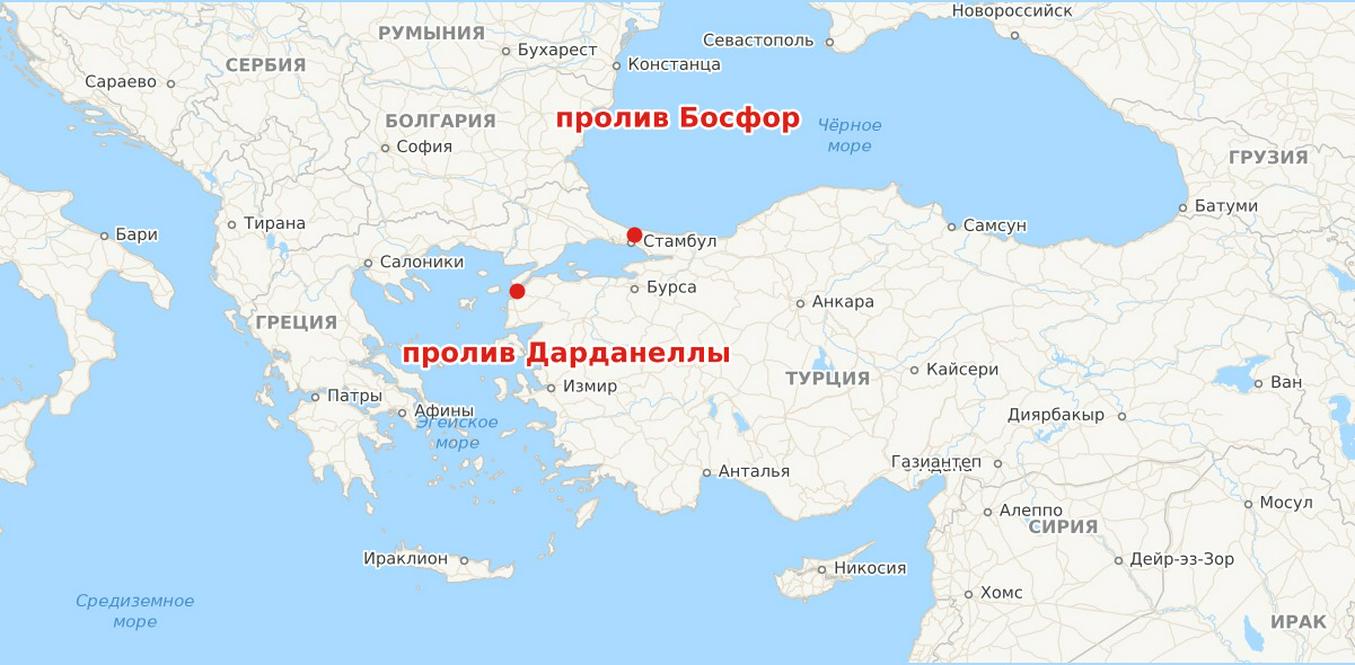
Turkey has begun restricting the passage of commercial vessels into the Black Sea through the Dardanelles Strait amid a surge in drone attacks on the merchant fleet. As Bloomberg reported, Turkey's General Directorate of Coastal Safety has notified several vessels bound for Novorossiysk — Russia's key port for oil and grain exports — that it will not issue permits for such voyages, or that it needs additional time to review the applications.
Bloomberg's sources say the restrictions have also affected vessels heading to Ukrainian ports; Ankara has offered no official explanation. As Meduza noted, ship-tracking data showed that, at the same time, vessels bound for Turkish and Bulgarian ports continued sailing north without hindrance.
The decision followed a string of strikes on civilian ships. On August 1, the container vessel Yanina came under drone attack. On August 3, the Turkish-flagged Nadezhda, sailing from Samsun to Novorossiysk with a cargo of vegetables and fruit, was hit: a fire broke out on board and several crew members were injured. On August 7, the Turkish dry-cargo ship MV Güllük was attacked off the coast of Novorossiysk. On August 4, Turkey's Foreign Ministry urged Russia and Ukraine to «urgently take concrete measures» to guarantee the safety of navigation, warning that further escalation would carry «multidimensional consequences,» including for food security.
Legally, Turkey cannot fully «close the Dardanelles» to commercial traffic. The straits regime is governed by the 1936 Montreux Convention, which, as the Lieber Institute at the West Point Military Academy explains, enshrines the principle of freedom of transit: as long as Turkey itself is not a belligerent, commercial vessels of any flag and cargo retain the right of passage even in wartime. Ankara may restrict commercial shipping only with respect to states with which it is at war — unlike warships, whose access it already curtailed back in 2022.
Turkey's actual toolkit, then, looks different: not a ban but an administrative squeeze — mandatory pilotage, insurance requirements, sanitary and technical inspections, queue management and permit reviews. That is precisely the mechanism now in use, judging by Bloomberg's account: vessels aren't turned back, they're left in indefinite limbo. The effect resembles a closure, but formally it stays within the bounds of Montreux — a distinction that matters, since an outright violation of the convention would open a debate Ankara wants no part of: a wholesale revision of the straits regime.
The scale of what's at stake is set by the traffic volumes involved. According to Türkiye Today's calculations, based on data from the General Directorate of Maritime Affairs, 84,640 vessels with a combined tonnage of 1.58 billion gross tons passed through the Bosphorus and the Dardanelles in 2025 — 40,172 through the Bosphorus and 44,468 through the Dardanelles. In the first half of 2026, BTA news agency reported that 40,218 vessels transited the straits, versus 40,988 a year earlier — a modest decline of roughly 2% so far. In other words, this is a waterway carrying some 80,000-85,000 vessels a year, where even a week's delay at the entrance builds a backlog that can take months to clear through the entire chartering chain.
The first industry to feel the pinch is oil — and the main casualty isn't Russia but Kazakhstan. More than 80% of Kazakhstan's oil exports move through the Caspian Pipeline Consortium terminal near Novorossiysk, roughly 1.5 million barrels a day, or about 1.8% of global supply.
Turkey's restrictions land on an already strained global market, compounding reduced flows from the Persian Gulf. For Ankara, the current measures are a way to limit its own exposure without breaching Montreux and without becoming a party to the conflict: the ships that were hit sailed under the Turkish flag, and the government has no appetite for explaining sailors' deaths in someone else's war to its own voters.
For Kazakhstan and Uzbekistan, whose trade is increasingly tied to Black Sea and trans-Black Sea routes, this is yet another reminder that diversifying transport corridors is no longer a topic confined to strategy papers — it's now a line item in this year's budget.