 Photo: press service of the president of Uzbekistan
Uzbekistan has signed agreements on six major energy projects worth a total of $4.7 billion, providing for 3 GW of generating capacity and 400 MW of energy storage. The president's press service reported the news.
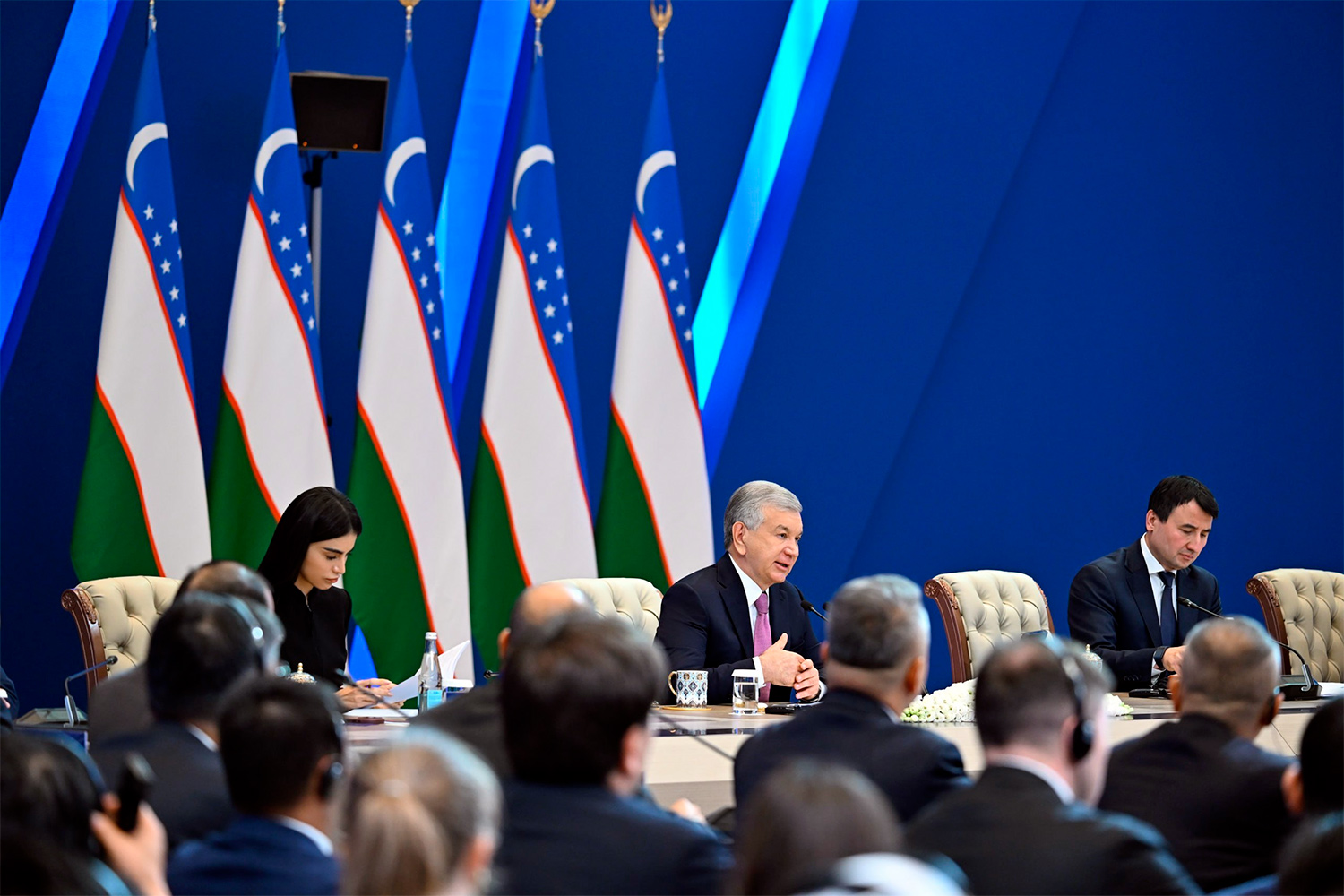
The documents were signed on the day of President Shavkat Mirziyoyev's open dialogue with investors on accelerating reforms in the fuel and energy sector. The head of state stressed that a stable energy supply is essential for economic development and higher living standards.
According to Mirziyoyev, the country's energy market has opened to private investment over the past decade, and public-private partnership mechanisms have been introduced. During that period, the sector has attracted $35 billion in investment. The share of renewable energy sources in total generation has reached 31% thanks to the development of solar, wind and hydropower.
The president noted that a new stage in attracting energy investment is beginning. Every project must now not only add new capacity but also improve supply reliability and reduce electricity losses. By 2030, the country plans to build 22,000 MW of new capacity, raise annual electricity output to more than 129 billion kWh and increase the share of renewables to 54%.
To achieve this, generation, transmission and storage systems will be developed in an interconnected way. Investors will be informed in advance of the terms for land allocation, grid connections and electricity procurement.
Projects for six solar and wind power plants with a combined capacity of 2.2 GW will soon be put out to tender.
The authorities will draw up a National Master Plan for Energy Development through 2050. By 2030, the country will build 5,000 kilometers of power grids and 16 large substations, and raise energy storage capacity to 4.5 GW. The president said reliable power supply for industrial enterprises and data centers must be secured well in advance.
The head of state stressed that investment projects should also open new opportunities for domestic industry. Twelve projects worth a total of $850 million have been prepared to localize the production of high-voltage equipment, energy storage systems and wind turbine components. A special industrial zone will be created in the Farish district of the Jizzakh region to manufacture products needed for the construction of a nuclear power plant.
In the oil and gas sector, cooperation will be expanded in geological exploration, more efficient field development and deep processing of raw materials. Exploration is under way on six investment blocks in the Ustyurt region together with SOCAR and British Petroleum. In other regions, another 128 blocks have been prepared, with estimated reserves of 5.8 trillion cubic meters of gas and 560 million tons of liquid hydrocarbons. Competition, transparency and efficiency will be the main criteria for their development, the president stressed.
Addressing the phased introduction of market mechanisms into the liquefied gas supply system, the president stressed that uninterrupted deliveries, safety and quality of service for the public must remain the priorities. Currently, 3.8 million households in Uzbekistan use liquefied gas.
Mirziyoyev also proposed expanding investors' participation in training specialists for new energy facilities. Starting next academic year, admission quotas for energy-related programs will be increased, and state grants will be allocated for 50 young people to study at leading foreign universities each year. Saudi company ACWA plans to equip technical colleges in Karakalpakstan, Bukhara and Syrdarya with the necessary equipment and to train hundreds of young people every year in new energy fields. The president urged other investors to take part in training specialists who meet international standards and said he was ready to hand over the management of local technical colleges to them.
Investors proposed resolving issues related to land allocation, grid connections and technical specifications through ongoing dialogue. It was decided to establish an Investor Council for the fuel and energy sector. Chaired by the head of the Presidential Administration, the council will promptly address issues arising at every stage, from project preparation to commissioning.
After the event, Shavkat Mirziyoyev held separate meetings with representatives of several companies. In particular, he discussed cooperation with the heads of ACWA (Saudi Arabia), SOCAR (Azerbaijan) and British Petroleum (United Kingdom), Cengiz Holding (Turkey), and Masdar and AMEA Power (United Arab Emirates).