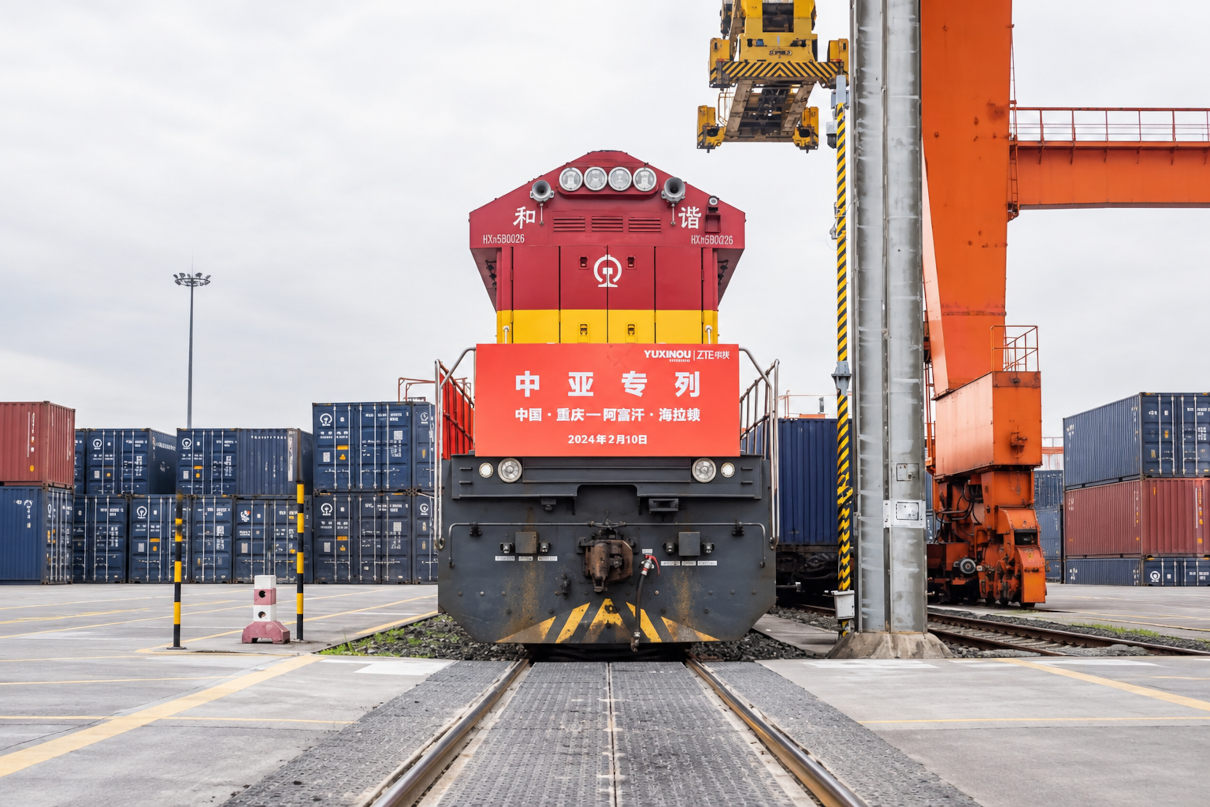
 A freight train departs a railway station in China's Shandong Province. Photo via Khaama.
The first dedicated freight train from China’s Shandong Province has departed for Afghanistan along a newly established route. Carrying goods valued at approximately 8 million yuan (around $1.1 million), the train is scheduled to arrive at the Hairatan dry port in northern Afghanistan in about 20 days, Afghan news agency Khaama Press reported on October 23.
The shipment includes textiles, chemical raw materials, tools, and construction machinery manufactured in Linyi, Shandong Province. The route transits Kazakhstan and Uzbekistan before crossing the Afghan border near Termez and heading into Balkh Province.
This marks the first dedicated freight rail service connecting Shandong directly to Hairatan.
Previously, shipments from the Chinese province reached Afghanistan primarily by road or through combined road-and-rail links. According to Chinese state media, those routes incurred higher costs and suffered from unpredictable transit times.
The new corridor aims to expand overland trade between China and Afghanistan while serving as an alternative to transit routes through Pakistan, particularly via the Port of Karachi, through which most Afghan imports traditionally flow.
Direct rail links between the two nations are advancing along other corridors as well. Earlier, a freight train from Haimen in China’s Jiangsu Province arrived in Hairatan hauling over 2,000 tons of goods valued at more than $20 million. That journey across Kazakhstan and Uzbekistan took 12 days. Operators plan to run bi-monthly round-trip services on that corridor, allowing Afghan exporters to send domestic goods directly to China.
Expanding rail corridors is critical for landlocked Afghanistan, where domestic track infrastructure remains sparse. Operational lines currently link the Uzbek border to the Mazar-i-Sharif area, while connections with Iran continue to develop along the Khaf–Herat railway.
Chinese officials expect the new overland link to slash transport overhead and streamline trade flows. However, its long-term commercial viability will hinge on freight rates, scheduled reliability, and actual transit speeds.