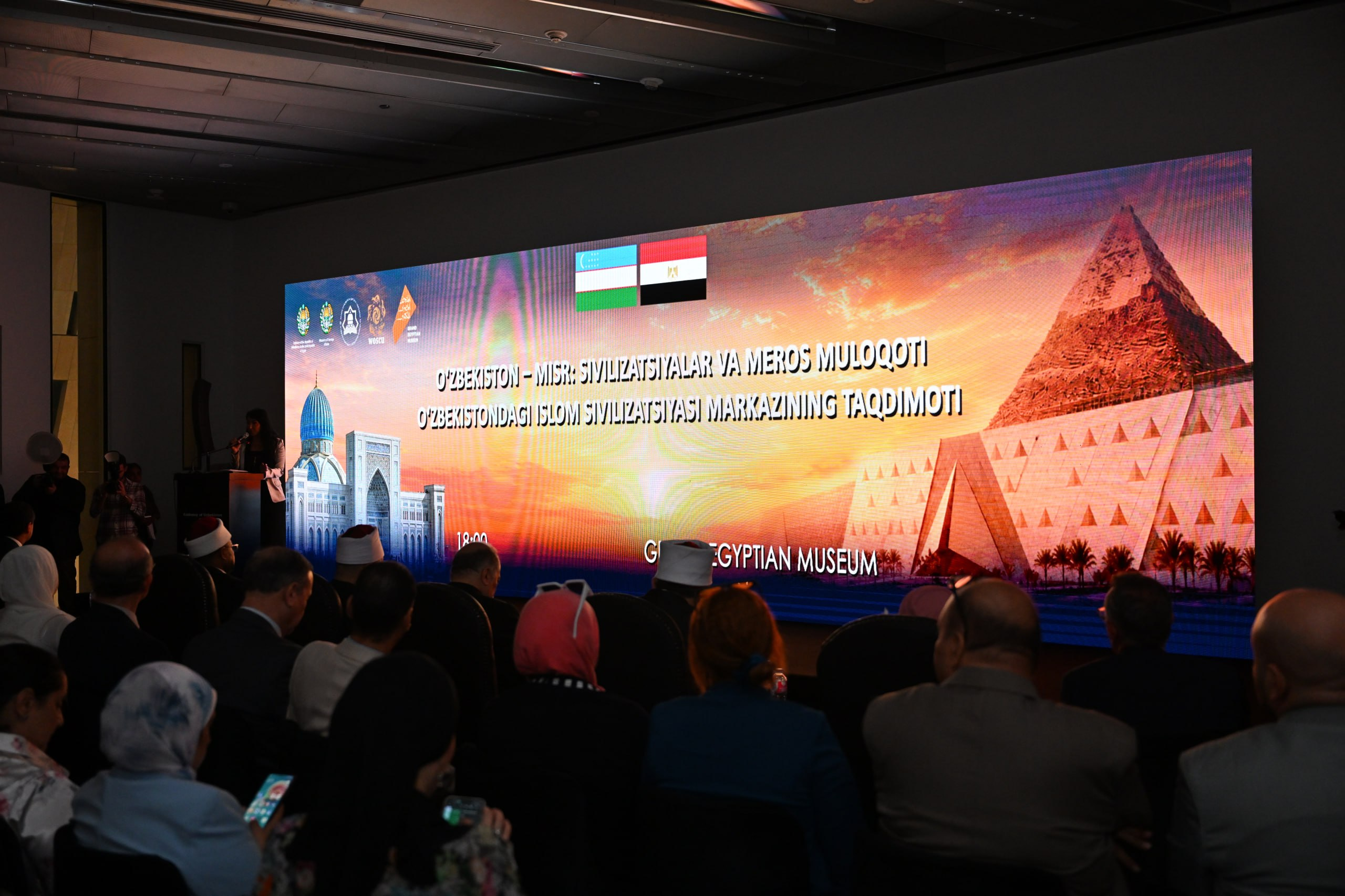
 Presentation of the Center. Photo by CIC press service
Uzbekistan's Center for Islamic Civilization was presented in Cairo, according to the CIC press service. The event took place on June 13 at the Grand Egyptian Museum near the Pyramids of Giza.
The presentation was held as part of the media event «Uzbekistan–Egypt: A Dialogue of Civilizations and Islamic Heritage.» It was organized by the Center for Islamic Civilization, Uzbekistan's Ministry of Foreign Affairs, the Embassy of Uzbekistan in Egypt, and the World Society for the Study, Preservation, and Popularization of Uzbekistan's Cultural Heritage.
Participants watched a film about the CIC, after which the center's director, Firdavs Abdukhalikov, delivered an address. He said Uzbekistan is counting on cooperation with scientific, educational, and cultural institutions in Egypt to study and preserve their shared historical heritage.
«Uzbekistan and Egypt are connected by centuries-old traditions of science, enlightenment, and spirituality. The Center for Islamic Civilization, established on the initiative of the President of the Republic of Uzbekistan, Shavkat Mirziyoyev, is today an authoritative international platform for studying, preserving, and popularizing the rich heritage of the Islamic world. We are open to broad international cooperation with the scientific, educational, and cultural institutions of Egypt in preserving and popularizing our common historical heritage,» Abdukhalikov said.
The presentation also featured a documentary film, narrated by Ben Kingsley, about the contribution of the scholars and thinkers of Maverannahr to the development of world science and culture. Participants were additionally shown a video about the historical and modern ties between Uzbekistan and Egypt.
Greetings were delivered by Uzbekistan's Foreign Minister Bakhtiyor Saidov, Egypt's Minister of Tourism and Antiquities Sherif Fathy, former Egyptian Culture Minister Jihan Zaki, and the executive director of the Grand Egyptian Museum, Ahmed Ghoneim, as well as representatives of Al-Azhar University, ICESCO, Egypt's Ministry of Awqaf, and the scientific and museum community.
During the speeches, participants discussed the connections between the scientific schools of Maverannahr and Cairo. Special mention was made of the legacy of Imam Bukhari, Imam Termizi, Imam Maturidi, Burhaniddin Marginani, Zamakhshari, and other scholars whose works were studied in Islamic educational centers, including Al-Azhar.
Fathy said Uzbekistan possesses significant cultural heritage and holds a special place in the history of Islamic culture. «I have already had the opportunity to visit several beautiful cities in your country, and I very much look forward to visiting the Center for Islamic Civilization in Uzbekistan,» he said.
As part of the event, the exhibition «Cultural Heritage of Uzbekistan – the Heritage of All Mankind» opened. It featured book albums, facsimile copies of Islamic manuscripts, examples of Islamic art and oriental miniatures, and multimedia projects about the Uthmanic Mushaf and the manuscript heritage of Maverannahr.
The Grand Egyptian Museum also received a gift of the «Cultural Heritage of Uzbekistan» book-album series. The museum's management was presented with a certificate transferring the publications to the complex's scientific and educational collection.
Separately, the event addressed preparations for the first international forum «Islamic Civilization: A Path of Peace, Tolerance, and Enlightenment,» to be held in Uzbekistan on July 7–11, 2026. Representatives of Egyptian scientific, museum, and academic institutions were invited to take part.
The Center for Islamic Civilization was built in the Uzbek capital near the Khast-Imam complex. Designed in the style of medieval architectural monuments, it features four portals 34 meters high and a central dome reaching 65 meters. It includes a Quran hall, a conference hall seating 460 people, and a museum whose exhibitions will cover the entire history of Uzbekistan, from pre-Islamic times to the present. The CIC is intended to become a platform for studying the legacy of ancestors and its contemporary interpretation, in collaboration with the International Islamic Academy of Uzbekistan and with scientific and educational centers worldwide.